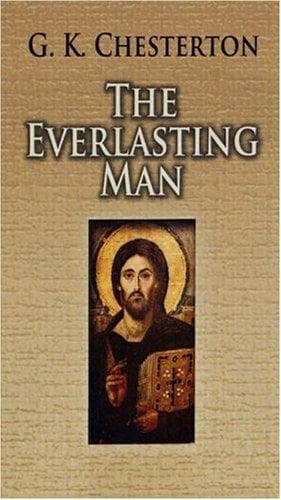
The Everlasting ManChesterton, G. K. (Gilbert Keith)
Religion
The Everlasting Man
Chesterton, G. K. (Gilbert Keith)
Catholic Church -- Apologetic works; Christianity and other religions; Religion
which Brahma and all that has the breath of life would be subject to
Siva, shining with the eye of death.
That the early Church was itself full of an ecstatic enthusiasm for
renunciation and virginity makes this distinction much more striking and
not less so. It makes all the more important the place where the dogma
drew the line. A man might crawl about on all fours like a beast because
he was an ascetic. He might stand night and day on the top of a pillar
and be adored for being an ascetic. But he could not say that the world
was a mistake or the marriage state a sin without being a heretic. What
was it that thus deliberately disengaged itself from eastern asceticism
by sharp definition and fierce refusal, if it was not something with an
individuality of its own; and one that was quite different? If the
Catholics are to be confused with the Gnostics, we can only say it was
not their fault if they are. And it is rather hard that the Catholics
should be blamed by the same critics for persecuting the heretics and
also for sympathising with the heresy.
The Church was not a Manichean movement, if only because it was not a
movement at all. It was not even merely an ascetical movement, because
it was not a movement at all. It would be nearer the truth to call it
the tamer of asceticism than the mere leader or loosener of it. It was a
thing having its own theory of asceticism, its own type of asceticism,
but most conspicuous at the moment as the moderator of other theories
and types. This is the only sense that can be made, for instance, of the
story of St. Augustine. As long as he was a mere man of the world, a
mere man drifting with his time, he actually was a Manichean. It really
was quite modern and fashionable to be a Manichean. But when he became a
Catholic, the people he instantly turned on and rent in pieces were the
Manicheans. The Catholic way of putting it is that he left off being a
pessimist to become an ascetic. But as the pessimists interpreted
asceticism, it might be said that he left off being an ascetic to become
a saint. The war upon life, the denial of nature, were exactly the
things he had already found in the heathen world outside the Church, and
had to renounce when he entered the Church. The very fact that St.
Augustine remains a somewhat sterner or sadder figure than St. Francis
or St. Teresa only accentuates the dilemma. Face to face with the
gravest or even grimmest of Catholics, we can still ask, ‘Why did
Catholicism make war on Manichees, if Catholicism was Manichean?’
Public-domain text, read in full here on John Shaqi.
Reviews
Reviews
No reviews yet
Be the first to share your thoughts on this work.
Elsewhere in the archive
Join the Discussion
Join the discussion
Sign in to leave a comment or review.
Sign InorCreate an account