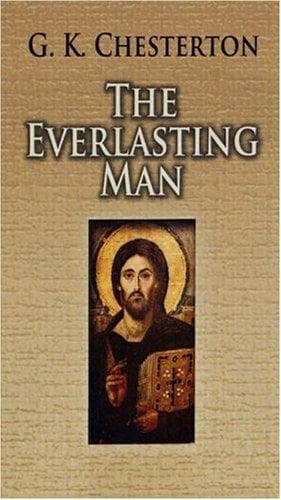
The Everlasting ManChesterton, G. K. (Gilbert Keith)
Religion
The Everlasting Man
Chesterton, G. K. (Gilbert Keith)
Catholic Church -- Apologetic works; Christianity and other religions; Religion
Take another rationalistic explanation of the rise of Christendom. It is
common enough to find another critic saying, ‘Christianity did not
really rise at all; that is, it did not merely rise from below; it was
imposed from above. It is an example of the power of the executive,
especially in despotic states. The Empire was really an Empire; that is,
it was really ruled by the Emperor. One of the Emperors happened to
become a Christian. He might just as well have become a Mithraist or a
Jew or a Fire-Worshipper; it was common in the decline of the Empire for
eminent and educated people to adopt these eccentric eastern cults. But
when he adopted it, it became the official religion of the Roman Empire;
and when it became the official religion of the Roman Empire, it became
as strong, as universal, and as invincible as the Roman Empire. It has
only remained in the world as a relic of that Empire; or, as many have
put it, it is but the ghost of Caesar still hovering over Rome.’ This
also is a very ordinary line taken in the criticism of orthodoxy, to say
that it was only officialism that ever made it orthodoxy. And here again
we can call on the heretics to refute it.
The whole great history of the Arian heresy might have been invented to
explode this idea. It is a very interesting history often repeated in
this connection; and the upshot of it is in that in so far as there ever
was a merely official religion, it actually died because it was a merely
official religion; and what destroyed it was the real religion. Arius
advanced a version of Christianity which moved, more or less vaguely, in
the direction of what we should call Unitarianism; though it was not the
same, for it gave to Christ a curious intermediary position between the
divine and human. The point is that it seemed to many more reasonable
and less fanatical; and among these were many of the educated class in a
sort of reaction against the first romance of conversion. Arians were a
sort of moderates and a sort of modernists. And it was felt that after
the first squabbles this was the final form of rationalised religion
into which civilisation might well settle down. It was accepted by Divus
Caesar himself and became the official orthodoxy; the generals and
military princes drawn from the new barbarian powers of the north, full
of the future, supported it strongly. But the sequel is still more
important. Exactly as a modern man might pass through Unitarianism to
complete agnosticism, so the greatest of the Arian emperors ultimately
shed the last and thinnest pretence of Christianity; he abandoned even
Arius and returned to Apollo. He was a Caesar of the Caesars; a soldier,
a scholar, a man of large ambitions and ideals; another of the
philosopher kings. It seemed to him as if at his signal the sun rose
again. The oracles began to speak like birds beginning to sing at dawn;
paganism was itself again; the gods returned. It seemed the end of that
strange interlude of an alien superstition.
Public-domain text, read in full here on John Shaqi.
Reviews
Reviews
No reviews yet
Be the first to share your thoughts on this work.
Elsewhere in the archive
Join the Discussion
Join the discussion
Sign in to leave a comment or review.
Sign InorCreate an account