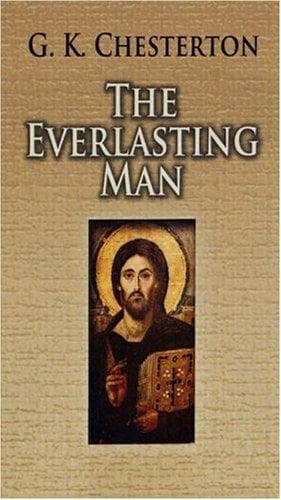
The Everlasting ManChesterton, G. K. (Gilbert Keith)
Religion
The Everlasting Man
Chesterton, G. K. (Gilbert Keith)
Catholic Church -- Apologetic works; Christianity and other religions; Religion
And indeed it was the end of
it, so far as there was a mere interlude of mere superstition. It was
the end of it, in so far as it was the fad of an emperor or the fashion
of a generation. If there really was something that began with
Constantine, then it ended with Julian.
But there was something that did not end. There had arisen in that hour
of history, defiant above the democratic tumult of the Councils of the
Church, Athanasius against the world. We may pause upon the point at
issue; because it is relevant to the whole of this religious history,
and the modern world seems to miss the whole point of it. We might put
it this way. If there is one question which the enlightened and liberal
have the habit of deriding and holding up as a dreadful example of
barren dogma and senseless sectarian strife, it is this Athanasian
question of the Co-Eternity of the Divine Son. On the other hand, if
there is one thing that the same liberals always offer us as a piece of
pure and simple Christianity, untroubled by doctrinal disputes, it is
the single sentence, ‘God is Love.’ Yet the two statements are almost
identical; at least one is very nearly nonsense without the other. The
barren dogma is only the logical way of stating the beautiful sentiment.
For if there be a being without beginning, existing before all things,
was He loving when there was nothing to be loved? If through that
unthinkable eternity He is lonely, what is the meaning of saying He is
love? The only justification of such a mystery is the mystical
conception that in His own nature there was something analogous to
self-expression; something of what begets and beholds what it has
begotten. Without some such idea, it is really illogical to complicate
the ultimate essence of deity with an idea like love. If the moderns
really want a simple religion of love, they must look for it in the
Athanasian Creed. The truth is that the trumpet of true Christianity,
the challenge of the charities and simplicities of Bethlehem or
Christmas Day, never rang out more arrestingly and unmistakably than in
the defiance of Athanasius to the cold compromise of the Arians. It was
emphatically he who really was fighting for a God of Love against a God
of colourless and remote cosmic control; the God of the stoics and the
agnostics. It was emphatically he who was fighting for the Holy Child
against the grey deity of the Pharisees and the Sadducees. He was
fighting for that very balance of beautiful interdependence and
intimacy, in the very Trinity of the Divine Nature, that draws our
hearts to the Trinity of the Holy Family. His dogma, if the phrase be
not misunderstood, turns even God into a Holy Family.
Public-domain text, read in full here on John Shaqi.
Reviews
Reviews
No reviews yet
Be the first to share your thoughts on this work.
Elsewhere in the archive
Join the Discussion
Join the discussion
Sign in to leave a comment or review.
Sign InorCreate an account