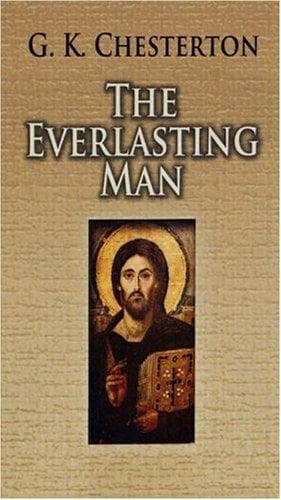
The Everlasting ManChesterton, G. K. (Gilbert Keith)
Religion
The Everlasting Man
Chesterton, G. K. (Gilbert Keith)
Catholic Church -- Apologetic works; Christianity and other religions; Religion
That this purely Christian dogma actually for a second time rebelled
against the Empire, and actually for a second time refounded the Church
in spite of the Empire, is itself a proof that there was something
positive and personal working in the world, other than whatever official
faith the Empire chose to adopt. This power utterly destroyed the
official faith that the Empire did adopt. It went on its own way as it
is going on its own way still. There are any number of other examples in
which is repeated precisely the same process we have reviewed in the
case of the Manichean and the Arian. A few centuries afterwards, for
instance, the Church had to maintain the same Trinity, which is simply
the logical side of love, against another appearance of the isolated and
simplified deity in the religion of Islam. Yet there are some who cannot
see what the Crusaders were fighting for; and some even who talk as if
Christianity had never been anything but a form of what they call
Hebraism coming in with the decay of Hellenism. Those people must
certainly be very much puzzled by the war between the Crescent and the
Cross. If Christianity had never been anything but a simpler morality
sweeping away polytheism, there is no reason why Christendom should not
have been swept into Islam. The truth is that Islam itself was a
barbaric reaction against that very humane complexity that is really a
Christian character; that idea of balance in the deity, as of balance in
the family, that makes that creed a sort of sanity, and that sanity the
soul of civilisation. And that is why the Church is from the first a
thing holding its own position and point of view, quite apart from the
accidents and anarchies of its age. That is why it deals blows
impartially right and left, at the pessimism of the Manichean or the
optimism of the Pelagian. It was not a Manichean movement because it was
not a movement at all. It was not an official fashion because it was not
a fashion at all. It was something that could coincide with movements
and fashions, could control them and could survive them.
Public-domain text, read in full here on John Shaqi.
Reviews
Reviews
No reviews yet
Be the first to share your thoughts on this work.
Elsewhere in the archive
Join the Discussion
Join the discussion
Sign in to leave a comment or review.
Sign InorCreate an account