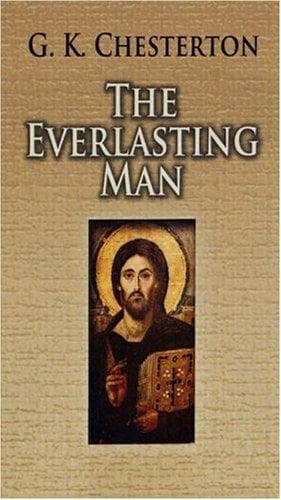
The Everlasting ManChesterton, G. K. (Gilbert Keith)
Religion
The Everlasting Man
Chesterton, G. K. (Gilbert Keith)
Catholic Church -- Apologetic works; Christianity and other religions; Religion
Indeed I once knew a lady who half-humorously suggested that the cave
was a crèche, in which the babies were put to be specially safe, and
that coloured animals were drawn on the walls to amuse them; very much
as diagrams of elephants and giraffes adorn a modern infant school. And
though this was but a jest, it does draw attention to some of the other
assumptions that we make only too readily. The pictures do not prove
even that the cave-men lived in caves, any more than the discovery of a
wine-cellar in Balham (long after that suburb had been destroyed by
human or divine wrath) would prove that the Victorian middle classes
lived entirely underground. The cave might have had a special purpose
like the cellar; it might have been a religious shrine or a refuge in
war or the meeting-place of a secret society or all sorts of things. But
it is quite true that its artistic decoration has much more of the
atmosphere of a nursery than of any of these nightmares of anarchical
fury and fear. I have conceived a child as standing in the cave; and it
is easy to conceive any child, modern or immeasurably remote, as making
a living gesture as if to pat the painted beasts upon the wall. In that
gesture there is a foreshadowing, as we shall see later, of another
cavern and another child.
But suppose the boy had not been taught by a priest but by a professor,
by one of the professors who simplify the relation of men and beasts to
a mere evolutionary variation. Suppose the boy saw himself, with the
same simplicity and sincerity, as a mere Mowgli running with the pack of
nature and roughly indistinguishable from the rest save by a relative
and recent variation. What would be for him the simplest lesson of that
strange stone picture-book? After all, it would come back to this; that
he had dug very deep and found the place where a man had drawn a picture
of a reindeer. But he would dig a good deal deeper before he found a
place where a reindeer had drawn a picture of a man. That sounds like a
truism, but in this connection it is really a very tremendous truth. He
might descend to depths unthinkable, he might sink into sunken
continents as strange as remote stars, he might find himself in the
inside of the world as far from men as the other side of the moon; he
might see in those cold chasms or colossal terraces of stone, traced in
the faint hieroglyphic of the fossil, the ruins of lost dynasties of
biological life, rather like the ruins of successive creations and
separate universes than the stages in the story of one. He would find
the trail of monsters blindly developing in directions outside all our
common imagery of fish and bird; groping and grasping and touching life
with every extravagant elongation of horn and tongue and tentacle;
growing a forest of fantastic caricatures of the claw and the fin and
the finger. But nowhere would he find one finger that had traced one
significant line upon the sand; nowhere one claw that had even begun to
Public-domain text, read in full here on John Shaqi.
Reviews
Reviews
No reviews yet
Be the first to share your thoughts on this work.
Join the Discussion
Join the discussion
Sign in to leave a comment or review.
Sign InorCreate an account