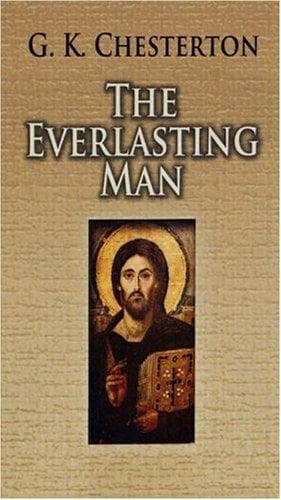
The Everlasting ManChesterton, G. K. (Gilbert Keith)
Religion
The Everlasting Man
Chesterton, G. K. (Gilbert Keith)
Catholic Church -- Apologetic works; Christianity and other religions; Religion
scratch the faint suggestion of a form. To all appearance, the thing
would be as unthinkable in all those countless cosmic variations of
forgotten aeons as it would be in the beasts and birds before our eyes.
The child would no more expect to see it than to see the cat scratch on
the wall a vindictive caricature of the dog. The childish common sense
would keep the most evolutionary child from expecting to see anything
like that; yet in the traces of the rude and recently evolved ancestors
of humanity he would have seen exactly that. It must surely strike him
as strange that men so remote from him should be so near, and that
beasts so near to him should be so remote. To his simplicity it must
seem at least odd that he could not find any trace of the beginning of
any arts among any animals. That is the simplest lesson to learn in the
cavern of the coloured pictures; only it is too simple to be learnt. It
is the simple truth that man does differ from the brutes in kind and not
in degree; and the proof of it is here; that it sounds like a truism to
say that the most primitive man drew a picture of a monkey, and that it
sounds like a joke to say that the most intelligent monkey drew a
picture of a man. Something of division and disproportion has appeared;
and it is unique. Art is the signature of man.
That is the sort of simple truth with which a story of the beginnings
ought really to begin. The evolutionist stands staring in the painted
cavern at the things that are too large to be seen and too simple to be
understood. He tries to deduce all sorts of other indirect and doubtful
things from the details of the pictures, because he cannot see the
primary significance of the whole; thin and theoretical deductions about
the absence of religion or the presence of superstition; about tribal
government and hunting and human sacrifice and heaven knows what. In the
next chapter I shall try to trace in a little more detail the much
disputed question about these prehistoric origins of human ideas and
especially of the religious idea. Here I am only taking this one case of
the cave as a sort of symbol of the simpler sort of truth with which the
story ought to start. When all is said, the main fact that the record of
the reindeer men attests, along with all other records, is that the
reindeer man could draw and the reindeer could not. If the reindeer man
was as much an animal as the reindeer, it was all the more extraordinary
that he could do what all other animals could not. If he was an ordinary
product of biological growth, like any other beast or bird, then it is
all the more extraordinary that he was not in the least like any other
beast or bird. He seems rather more supernatural as a natural product
than as a supernatural one.
Public-domain text, read in full here on John Shaqi.
Reviews
Reviews
No reviews yet
Be the first to share your thoughts on this work.
Join the Discussion
Join the discussion
Sign in to leave a comment or review.
Sign InorCreate an account