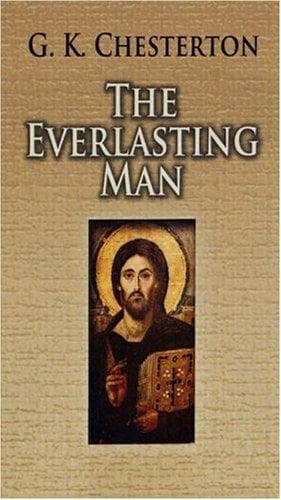
The Everlasting ManChesterton, G. K. (Gilbert Keith)
Religion
The Everlasting Man
Chesterton, G. K. (Gilbert Keith)
Catholic Church -- Apologetic works; Christianity and other religions; Religion
It is rather more obvious in the case of the Renaissance, simply because
the period is so much nearer to us and people know so much more about
it. But there is more even in that example than most people know. Apart
from the particular controversies which I wish to reserve for a separate
study, the period was far more chaotic than those controversies commonly
imply. When Protestants call Latimer a martyr to Protestantism, and
Catholics reply that Campion was a martyr to Catholicism, it is often
forgotten that many perished in such persecutions who could only be
described as martyrs to atheism or anarchism or even diabolism. That
world was almost as wild as our own; the men wandering about in it
included the sort of man who says there is no God, the sort of man who
says he is himself God, the sort of man who says something that nobody
can make head or tail of. If we could have the _conversation_ of the
age following the Renaissance, we should probably be shocked by its
shameless negations. The remarks attributed to Marlowe are probably
pretty typical of the talk in many intellectual taverns. The transition
from Pre-Reformation to Post-Reformation Europe was through a void of
very yawning questions; yet again in the long run the answer was the
same. It was one of those moments when, as Christ walked on the water,
so was Christianity walking in the air.
But all these cases are remote in date and could only be proved in
detail. We can see the fact much more clearly in the case when the
paganism of the Renaissance ended Christianity and Christianity
unaccountably began all over again. But we can see it most clearly of
all in the case which is close to us and full of manifest and minute
evidence; the case of the great decline of religion that began about the
time of Voltaire. For indeed it is our own case; and we ourselves have
seen the decline of that decline. The two hundred years since Voltaire
do not flash past us at a glance like the fourth and fifth centuries or
the twelfth and thirteenth centuries. In our own case we can see this
oft-repeated process close at hand; we know how completely a society can
lose its fundamental religion without abolishing its official religion;
we know how men can all become agnostics long before they abolish
bishops. And we know that also in this last ending, which really did
look to us like the final ending, the incredible thing has happened
again; the Faith has a better following among the young men than among
the old. When Ibsen spoke of the new generation knocking at the door, he
certainly never expected that it would be the church-door.
At least five times, therefore, with the Arian and the Albigensian, with
the Humanist sceptic, after Voltaire and after Darwin, the Faith has to
all appearance gone to the dogs. In each of these five cases it was the
dog that died. How complete was the collapse and how strange the
reversal, we can only see in detail in the case nearest to our own time.
Public-domain text, read in full here on John Shaqi.
Reviews
Reviews
No reviews yet
Be the first to share your thoughts on this work.
Elsewhere in the archive
Join the Discussion
Join the discussion
Sign in to leave a comment or review.
Sign InorCreate an account