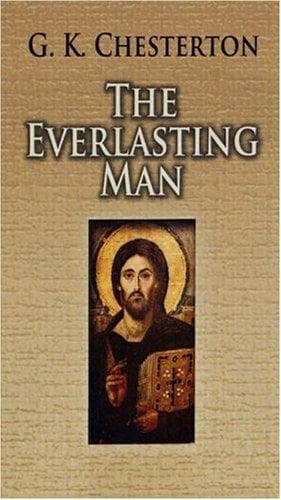
The Everlasting ManChesterton, G. K. (Gilbert Keith)
Religion
The Everlasting Man
Chesterton, G. K. (Gilbert Keith)
Catholic Church -- Apologetic works; Christianity and other religions; Religion
But I have begun this story in the cave, like the cave of the
speculations of Plato, because it is a sort of model of the mistake of
merely evolutionary introductions and prefaces. It is useless to begin
by saying that everything was slow and smooth and a mere matter of
development and degree. For in a plain matter like the pictures there is
in fact not a trace of any such development or degree. Monkeys did not
begin pictures and men finish them; Pithecanthropus did not draw a
reindeer badly and Homo Sapiens draw it well. The higher animals did not
draw better and better portraits; the dog did not paint better in his
best period than in his early bad manner as a jackal; the wild horse was
not an Impressionist and the race-horse a Post-Impressionist. All we can
say of this notion of reproducing things in shadow or representative
shape is that it exists nowhere in nature except in man; and that we
cannot even talk about it without treating man as something separate
from nature. In other words, every sane sort of history must begin with
man as man, a thing standing absolute and alone. How he came there, or
indeed how anything else came there, is a thing for theologians and
philosophers and scientists and not for historians. But an excellent
test case of this isolation and mystery is the matter of the impulse of
art. This creature was truly different from all other creatures; because
he was a creator as well as a creature. Nothing in that sense could be
made in any other image but the image of man. But the truth is so true
that, even in the absence of any religious belief, it must be assumed in
the form of some moral or metaphysical principle. In the next chapter we
shall see how this principle applies to all the historical hypotheses
and evolutionary ethics now in fashion; to the origins of tribal
government or mythological belief. But the clearest and most convenient
example to start with is this popular one of what the cave-man really
did in his cave. It means that somehow or other a new thing had appeared
in the cavernous night of nature; a mind that is like a mirror. It is
like a mirror because it is truly a thing of reflection. It is like a
mirror because in it alone all the other shapes can be seen like shining
shadows in a vision. Above all, it is like a mirror because it is the
only thing of its kind. Other things may resemble it or resemble each
other in various ways; other things may excel it or excel each other in
various ways; just as in the furniture of a room a table may be round
like a mirror or a cupboard may be larger than a mirror. But the mirror
is the only thing that can contain them all. Man is the microcosm; man
is the measure of all things; man is the image of God. These are the
only real lessons to be learnt in the cave, and it is time to leave it
for the open road.
Public-domain text, read in full here on John Shaqi.
Reviews
Reviews
No reviews yet
Be the first to share your thoughts on this work.
Join the Discussion
Join the discussion
Sign in to leave a comment or review.
Sign InorCreate an account