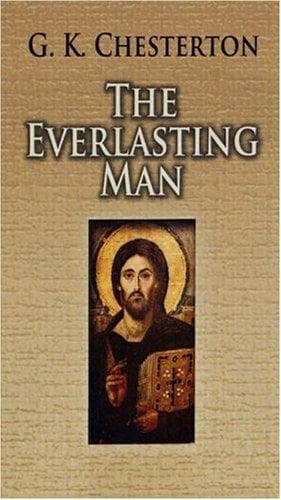
The Everlasting ManChesterton, G. K. (Gilbert Keith)
Religion
The Everlasting Man
Chesterton, G. K. (Gilbert Keith)
Catholic Church -- Apologetic works; Christianity and other religions; Religion
In the land lit by that neighbouring star, whose blaze is the broad
daylight, there are many and very various things, motionless and moving.
There moves among them a race that is in its relation to the others a
race of gods. The fact is not lessened but emphasised because it can
behave like a race of demons. Its distinction is not an individual
illusion, like one bird pluming itself on its own plumes; it is a solid
and a many-sided thing. It is demonstrated in the very speculations that
have led to its being denied. That men, the gods of this lower world,
are linked with it in various ways is true; but it is another aspect of
the same truth. That they grow as the grass grows and walk as the
beasts walk is a secondary necessity that sharpens the primary
distinction. It is like saying that a magician must after all have the
appearance of a man; or that even the fairies could not dance without
feet. It has lately been the fashion to focus the mind entirely on these
mild and subordinate resemblances and to forget the main fact
altogether. It is customary to insist that man resembles the other
creatures. Yes; and that very resemblance he alone can see. The fish
does not trace the fish-bone pattern in the fowls of the air; or the
elephant and the emu compare skeletons. Even in the sense in which man
is at one with the universe it is an utterly lonely universality. The
very sense that he is united with all things is enough to sunder him
from all.
Looking around him by this unique light, as lonely as the literal flame
that he alone has kindled, this demigod or demon of the visible world
makes that world visible. He sees around him a world of a certain style
or type. It seems to proceed by certain rules or at least repetitions.
He sees a green architecture that builds itself without visible hands;
but which builds itself into a very exact plan or pattern, like a design
already drawn in the air by an invisible finger. It is not, as is now
vaguely suggested, a vague thing. It is not a growth or a groping of
blind life. Each seeks an end; a glorious and radiant end, even for
every daisy or dandelion we see in looking across the level of a common
field. In the very shape of things there is more than green growth;
there is the finality of the flower. It is a world of crowns. This
impression, whether or no it be an illusion, has so profoundly
influenced this race of thinkers and masters of the material world, that
the vast majority have been moved to take a certain view of that world.
They have concluded, rightly or wrongly, that the world had a plan as
the tree seemed to have a plan; and an end and crown like the flower.
But so long as the race of thinkers was able to think, it was obvious
that the admission of this idea of a plan brought with it another
thought more thrilling and even terrible. There was some one else, some
strange and unseen being, who had designed these things, if indeed they
were designed.
Public-domain text, read in full here on John Shaqi.
Reviews
Reviews
No reviews yet
Be the first to share your thoughts on this work.
Elsewhere in the archive
Join the Discussion
Join the discussion
Sign in to leave a comment or review.
Sign InorCreate an account