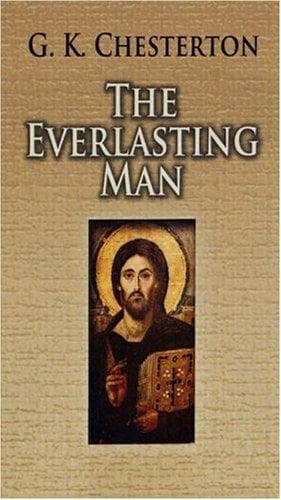
The Everlasting ManChesterton, G. K. (Gilbert Keith)
Religion
The Everlasting Man
Chesterton, G. K. (Gilbert Keith)
Catholic Church -- Apologetic works; Christianity and other religions; Religion
I do not imagine that they need any encouragement from the discovery of
a few highly doubtful bones. Anyhow, those bones are far too few and
fragmentary and dubious to fill up the whole of the vast void that does
in reason and in reality lie between man and his bestial ancestors, if
they were his ancestors. On the assumption of that evolutionary
connection (a connection which I am not in the least concerned to deny),
the really arresting and remarkable fact is the comparative absence of
any such remains recording that connection at that point. The sincerity
of Darwin really admitted this; and that is how we came to use such a
term as the Missing Link. But the dogmatism of Darwinians has been too
strong for the agnosticism of Darwin; and men have insensibly fallen
into turning this entirely negative term into a positive image. They
talk of searching for the habits and habitat of the Missing Link; as if
one were to talk of being on friendly terms with the gap in a narrative
or the hole in an argument, of taking a walk with a _non-sequitur_ or
dining with an undistributed middle.
In this sketch, therefore, of man in his relation to certain religious
and historical problems, I shall waste no further space on these
speculations on the nature of man before he became man. His body may
have been evolved from the brutes; but we know nothing of any such
transition that throws the smallest light upon his soul as it has shown
itself in history. Unfortunately the same school of writers pursue the
same style of reasoning when they come to the first real evidence about
the first real men. Strictly speaking of course we know nothing about
prehistoric man, for the simple reason that he was prehistoric. The
history of prehistoric man is a very obvious contradiction in terms. It
is the sort of unreason in which only rationalists are allowed to
indulge. If a parson had casually observed that the Flood was
antediluvian, it is possible that he might be a little chaffed about his
logic. If a bishop were to say that Adam was Preadamite, we might think
it a little odd. But we are not supposed to notice such verbal trifles
when sceptical historians talk of the part of history that is
prehistoric. The truth is that they are using the terms historic and
prehistoric without any clear test or definition in their minds. What
they mean is that there are traces of human lives before the beginning
of human stories; and in that sense we do at least know that humanity
was before history.
Public-domain text, read in full here on John Shaqi.
Reviews
Reviews
No reviews yet
Be the first to share your thoughts on this work.
Join the Discussion
Join the discussion
Sign in to leave a comment or review.
Sign InorCreate an account