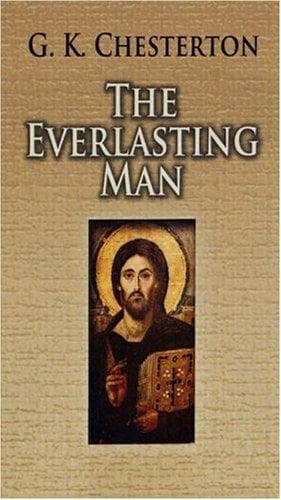
The Everlasting ManChesterton, G. K. (Gilbert Keith)
Religion
The Everlasting Man
Chesterton, G. K. (Gilbert Keith)
Catholic Church -- Apologetic works; Christianity and other religions; Religion
The point of this book, in other words, is that the next best thing to
being really inside Christendom is to be really outside it. And a
particular point of it is that the popular critics of Christianity are
not really outside it. They are on a debatable ground, in every sense
of the term. They are doubtful in their very doubts. Their criticism has
taken on a curious tone; as of a random and illiterate heckling. Thus
they make current an anti-clerical cant as a sort of small-talk. They
will complain of parsons dressing like parsons; as if we should be any
more free if all the police who shadowed or collared us were
plain-clothes detectives. Or they will complain that a sermon cannot be
interrupted, and call a pulpit a coward’s castle; though they do not
call an editor’s office a coward’s castle. It would be unjust both to
journalists and priests; but it would be much truer of journalists. The
clergyman appears in person and could easily be kicked as he came out of
church; the journalist conceals even his name so that nobody can kick
him. They write wild and pointless articles and letters in the press
about why the churches are empty, without even going there to find out
if they are empty, or which of them are empty. Their suggestions are
more vapid and vacant than the most insipid curate in a three-act farce,
and move us to comfort him after the manner of the curate in the Bab
Ballads; ‘Your mind is not so blank as that of Hopley Porter.’ So we may
truly say to the very feeblest cleric: ‘Your mind is not so blank as
that of Indignant Layman or Plain Man or Man in the Street, or any of
your critics in the newspapers; for they have not the most shadowy
notion of what they want themselves, let alone of what you ought to give
them.’ They will suddenly turn round and revile the Church for not
having prevented the War, which they themselves did not want to prevent;
and which nobody had ever professed to be able to prevent, except some
of that very school of progressive and cosmopolitan sceptics who are the
chief enemies of the Church. It was the anti-clerical and agnostic world
that was always prophesying the advent of universal peace; it is that
world that was, or should have been, abashed and confounded by the
advent of universal war. As for the general view that the Church was
discredited by the War--they might as well say that the Ark was
discredited by the Flood. When the world goes wrong, it proves rather
that the Church is right. The Church is justified, not because her
children do not sin, but because they do. But that marks their mood
about the whole religious tradition: they are in a state of reaction
against it. It is well with the boy when he lives on his father’s land;
and well with him again when he is far enough from it to look back on it
and see it as a whole. But these people have got into an intermediate
state, have fallen into an intervening valley from which they can see
neither the heights beyond them nor the heights behind.
Public-domain text, read in full here on John Shaqi.
Reviews
Reviews
No reviews yet
Be the first to share your thoughts on this work.
Join the Discussion
Join the discussion
Sign in to leave a comment or review.
Sign InorCreate an account