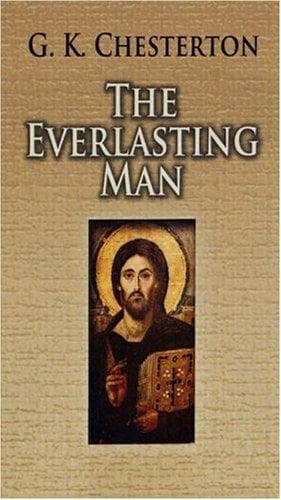
The Everlasting ManChesterton, G. K. (Gilbert Keith)
Religion
The Everlasting Man
Chesterton, G. K. (Gilbert Keith)
Catholic Church -- Apologetic works; Christianity and other religions; Religion
They cannot get
out of the penumbra of Christian controversy. They cannot be Christians
and they cannot leave off being Anti-Christians. Their whole atmosphere
is the atmosphere of a reaction: sulks, perversity, petty criticism.
They still live in the shadow of the faith and have lost the light of
the faith.
Now the best relation to our spiritual home is to be near enough to love
it. But the next best is to be far enough away not to hate it. It is the
contention of these pages that while the best judge of Christianity is a
Christian, the next best judge would be something more like a Confucian.
The worst judge of all is the man now most ready with his judgments; the
ill-educated Christian turning gradually into the ill-tempered agnostic,
entangled in the end of a feud of which he never understood the
beginning, blighted with a sort of hereditary boredom with he knows not
what, and already weary of hearing what he has never heard. He does not
judge Christianity calmly as a Confucian would; he does not judge it as
he would judge Confucianism. He cannot by an effort of fancy set the
Catholic Church thousands of miles away in strange skies of morning and
judge it as impartially as a Chinese pagoda. It is said that the great
St. Francis Xavier, who very nearly succeeded in setting up the Church
there as a tower overtopping all pagodas, failed partly because his
followers were accused by their fellow missionaries of representing the
Twelve Apostles with the garb or attributes of Chinamen. But it would be
far better to see them as Chinamen, and judge them fairly as Chinamen,
than to see them as featureless idols merely made to be battered by
iconoclasts; or rather as cockshies to be pelted by empty-headed
cockneys. It would be better to see the whole thing as a remote Asiatic
cult; the mitres of its bishops as the towering head-dresses of
mysterious bonzes; its pastoral staffs as the sticks twisted like
serpents carried in some Asiatic procession; to see the prayer-book as
fantastic as the prayer-wheel and the Cross as crooked as the Swastika.
Then at least we should not lose our temper as some of the sceptical
critics seem to lose their temper, not to mention their wits. Their
anti-clericalism has become an atmosphere, an atmosphere of negation and
hostility from which they cannot escape. Compared with that, it would be
better to see the whole thing as something belonging to another
continent, or to another planet. It would be more philosophical to stare
indifferently at bonzes than to be perpetually and pointlessly grumbling
at bishops. It would be better to walk past a church as if it were a
pagoda than to stand permanently in the porch, impotent either to go
inside and help or to go outside and forget. For those in whom a mere
reaction has thus become an obsession, I do seriously recommend the
imaginative effort of conceiving the Twelve Apostles as Chinamen. In
other words, I recommend these critics to try to do as much justice to
Public-domain text, read in full here on John Shaqi.
Reviews
Reviews
No reviews yet
Be the first to share your thoughts on this work.
Join the Discussion
Join the discussion
Sign in to leave a comment or review.
Sign InorCreate an account