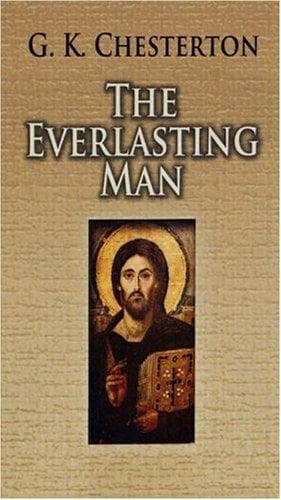
The Everlasting ManChesterton, G. K. (Gilbert Keith)
Religion
The Everlasting Man
Chesterton, G. K. (Gilbert Keith)
Catholic Church -- Apologetic works; Christianity and other religions; Religion
It is commonly affirmed, again, that religion grew in a very slow and
evolutionary manner; and even that it grew not from one cause, but from
a combination that might be called a coincidence. Generally speaking,
the three chief elements in the combination are, first, the fear of the
chief of the tribe (whom Mr. Wells insists on calling, with regrettable
familiarity, the Old Man), second, the phenomena of dreams, and third,
the sacrificial associations of the harvest and the resurrection
symbolised in the growing corn. I may remark in passing that it seems to
me very doubtful psychology to refer one living and single spirit to
three dead and disconnected causes, if they were merely dead and
disconnected causes. Suppose Mr. Wells, in one of his fascinating novels
of the future, were to tell us that there would arise among men a new
and as yet nameless passion, of which men will dream as they dream of
first love, for which they will die as they die for a flag and a
fatherland. I think we should be a little puzzled if he told us that
this singular sentiment would be a combination of the habit of smoking
Woodbines, the increase of the income tax and the pleasure of a motorist
in exceeding the speed limit. We could not easily imagine this, because
we could not imagine any connection between the three or any common
feeling that could include them all. Nor could any one imagine any
connection between corn and dreams and an old chief with a spear, unless
there was already a common feeling to include them all. But if there was
such a common feeling it could only be the religious feeling; and these
things could not be the beginnings of a religious feeling that existed
already. I think anybody’s common sense will tell him that it is far
more likely that this sort of mystical sentiment did exist already; and
that in the light of it dreams and kings and cornfields could appear
mystical then, as they can appear mystical now.
Public-domain text, read in full here on John Shaqi.
Reviews
Reviews
No reviews yet
Be the first to share your thoughts on this work.
Join the Discussion
Join the discussion
Sign in to leave a comment or review.
Sign InorCreate an account