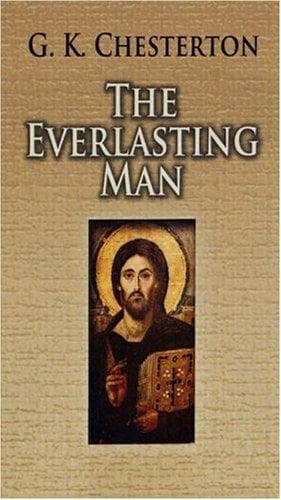
The Everlasting ManChesterton, G. K. (Gilbert Keith)
Religion
The Everlasting Man
Chesterton, G. K. (Gilbert Keith)
Catholic Church -- Apologetic works; Christianity and other religions; Religion
For the plain truth is that all this is a trick of making things seem
distant and dehumanised, merely by pretending not to understand things
that we do understand. It is like saying that prehistoric men had an
ugly and uncouth habit of opening their mouths wide at intervals and
stuffing strange substances into them, as if we had never heard of
eating. It is like saying that the terrible Troglodytes of the Stone Age
lifted alternate legs in rotation, as if we had never heard of walking.
If it were meant to touch the mystical nerve and awaken us to the
wonder of walking and eating, it might be a legitimate fancy. As it is
here intended to kill the mystical nerve and deaden us to the wonder of
religion, it is irrational rubbish. It pretends to find something
incomprehensible in the feelings that we all comprehend. Who does _not_
find dreams mysterious, and feel that they lie on the dark borderland of
being? Who does _not_ feel the death and resurrection of the growing
things of the earth as something near to the secret of the universe? Who
does _not_ understand that there must always be the savour of something
sacred about authority and the solidarity that is the soul of the tribe?
If there be any anthropologist who really finds these things remote and
impossible to realise, we can say nothing of that scientific gentleman
except that he has not got so large and enlightened a mind as a
primitive man. To me it seems obvious that nothing but a spiritual
sentiment already active could have clothed these separate and diverse
things with sanctity. To say that religion came _from_ reverencing a
chief or sacrificing at a harvest is to put a highly elaborate cart
before a really primitive horse. It is like saying that the impulse to
draw pictures came from the contemplation of the pictures of reindeers
in the cave. In other words, it is explaining painting by saying that it
arose out of the work of painters; or accounting for art by saying that
it arose out of art. It is even more like saying that the thing we call
poetry arose as the result of certain customs; such as that of an ode
being officially composed to celebrate the advent of spring; or that of
a young man rising at a regular hour to listen to the skylark and then
writing his report on a piece of paper. It is quite true that young men
often become poets in the spring; and it is quite true that when once
there are poets, no mortal power can restrain them from writing about
the skylark. But the poems did not exist before the poets. The poetry
did not arise out of the poetic forms. In other words, it is hardly an
adequate explanation of how a thing appeared for the first time to say
it existed already. Similarly, we cannot say that religion arose out of
the religious forms, because that is only another way of saying that it
only arose when it existed already. It needed a certain sort of mind to
see that there was anything mystical about the dreams or the dead, as it
Public-domain text, read in full here on John Shaqi.
Reviews
Reviews
No reviews yet
Be the first to share your thoughts on this work.
Join the Discussion
Join the discussion
Sign in to leave a comment or review.
Sign InorCreate an account