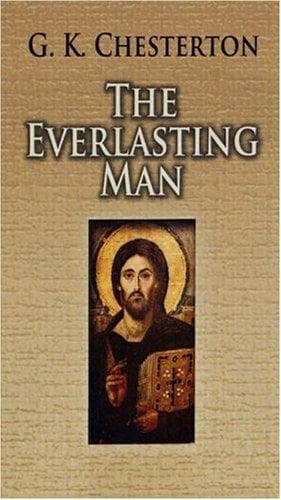
The Everlasting ManChesterton, G. K. (Gilbert Keith)
Religion
The Everlasting Man
Chesterton, G. K. (Gilbert Keith)
Catholic Church -- Apologetic works; Christianity and other religions; Religion
even dreams, considered merely as experiences, are their experiences as
much as ours. The only possible conclusion is that these experiences,
considered as experiences, do not generate anything like a religious
sense in any mind except a mind like ours. We come back to the fact of a
certain kind of mind as already alive and alone. It was unique and it
could make creeds as it could make cave-drawings. The materials for
religion had lain there for countless ages like the materials for
everything else; but the power of religion was in the mind. Man could
already see in these things the riddles and hints and hopes that he
still sees in them. He could not only dream but dream about dreams. He
could not only see the dead but see the shadow of death; and was
possessed with that mysterious mystification that for ever finds death
incredible.
It is quite true that we have even these hints chiefly about man when he
unmistakably appears as man. We cannot affirm this or anything else
about the alleged animal originally connecting man and the brutes. But
that is only because he is not an animal but an allegation. We cannot be
certain that Pithecanthropus ever worshipped, because we cannot be
certain that he ever lived. He is only a vision called up to fill the
void that does in fact yawn between the first creatures who were
certainly men and any other creatures that are certainly apes or other
animals. A few very doubtful fragments are scraped together to suggest
such an intermediate creature because it is required by a certain
philosophy; but nobody supposes that these are sufficient to establish
anything philosophical even in support of that philosophy. A scrap of
skull found in Java cannot establish anything about religion or about
the absence of religion. If there ever was any such ape-man, he may have
exhibited as much ritual in religion as a man or as much simplicity in
religion as an ape. He may have been a mythologist or he may have been a
myth. It might be interesting to inquire whether this mystical quality
appeared in a transition from the ape to the man, if there were really
any types of the transition to inquire about. In other words, the
missing link might or might not be mystical if he were not missing. But
compared with the evidence we have of real human beings, we have no
evidence that he was a human being or a half-human being or a being at
all. Even the most extreme evolutionists do not attempt to deduce any
evolutionary views about the origin of religion from _him_. Even in
trying to prove that religion grew slowly from rude or irrational
sources, they begin their proof with the first men who were men. But
their own proof only proves that the men who were already men were
already mystics. They used the rude and irrational elements as only men
and mystics can use them. We come back once more to the simple truth;
that at some time too early for these critics to trace, a transition had
Public-domain text, read in full here on John Shaqi.
Reviews
Reviews
No reviews yet
Be the first to share your thoughts on this work.
Join the Discussion
Join the discussion
Sign in to leave a comment or review.
Sign InorCreate an account