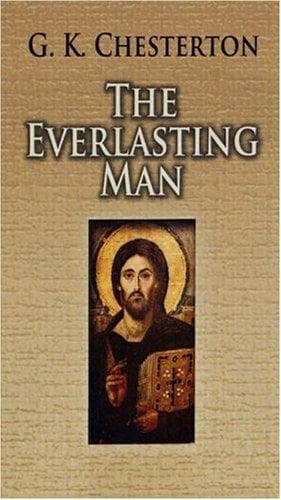
The Everlasting ManChesterton, G. K. (Gilbert Keith)
Religion
The Everlasting Man
Chesterton, G. K. (Gilbert Keith)
Catholic Church -- Apologetic works; Christianity and other religions; Religion
needed a particular sort of mind to see that there was anything poetical
about the skylark or the spring. That mind was presumably what we call
the human mind, very much as it exists to this day; for mystics still
meditate upon death and dreams as poets still write about spring and
skylarks. But there is not the faintest hint to suggest that anything
short of the human mind we know feels any of these mystical associations
at all. A cow in a field seems to derive no lyrical impulse or
instruction from her unrivalled opportunities for listening to the
skylark. And similarly there is no reason to suppose that live sheep
will ever begin to use dead sheep as the basis of a system of elaborate
ancestor-worship. It is true that in the spring a young quadruped’s
fancy may lightly turn to thoughts of love, but no succession of springs
has ever led it to turn however lightly to thoughts of literature. And
in the same way, while it is true that a dog has dreams, while most
other quadrupeds do not seem even to have that, we have waited a long
time for the dog to develop his dreams into an elaborate system of
religious ceremonial. We have waited so long that we have really ceased
to expect it; and we no more look to see a dog apply his dreams to
ecclesiastical construction than to see him examine his dreams by the
rules of psycho-analysis. It is obvious, in short, that for some reason
or other these natural experiences, and even natural excitements, never
do pass the line that separates them from creative expression like art
and religion, in any creature except man. They never do, they never
have, and it is now to all appearance very improbable that they ever
will. It is not impossible, in the sense of self-contradictory, that we
should see cows fasting from grass every Friday or going on their knees
as in the old legend about Christmas Eve. It is not in that sense
impossible that cows should contemplate death until they can lift up a
sublime psalm of lamentation to the tune the old cow died of. It is not
in that sense impossible that they should express their hopes of a
heavenly career in a symbolical dance, in honour of the cow that jumped
over the moon. It may be that the dog will at last have laid in a
sufficient store of dreams to enable him to build a temple to Cerberus
as a sort of canine trinity. It may be that his dreams have already
begun to turn into visions capable of verbal expression, in some
revelation about the Dog Star as the spiritual home for lost dogs. These
things are logically possible, in the sense that it is logically
difficult to prove the universal negative which we call an
impossibility. But all that instinct for the probable, which we call
common sense, must long ago have told us that the animals are not to all
appearance evolving in that sense; and that, to say the least, we are
not likely to have any personal evidence of their passing from the
animal experience to the human experiments. But spring and death and
Public-domain text, read in full here on John Shaqi.
Reviews
Reviews
No reviews yet
Be the first to share your thoughts on this work.
Join the Discussion
Join the discussion
Sign in to leave a comment or review.
Sign InorCreate an account