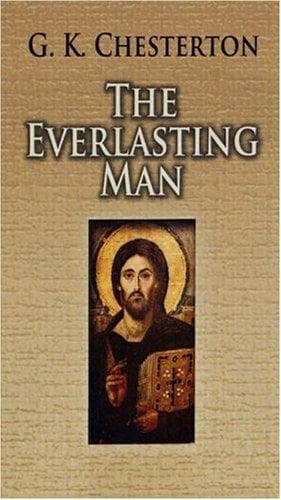
The Everlasting ManChesterton, G. K. (Gilbert Keith)
Religion
The Everlasting Man
Chesterton, G. K. (Gilbert Keith)
Catholic Church -- Apologetic works; Christianity and other religions; Religion
The modern man looking at the most ancient origins has been like a man
watching for daybreak in a strange land; and expecting to see that dawn
breaking behind bare uplands or solitary peaks. But that dawn is
breaking behind the black bulk of great cities long builded and lost for
us in the original night; colossal cities like the houses of giants, in
which even the carved ornamental animals are taller than the palm-trees;
in which the painted portrait can be twelve times the size of the man;
with tombs like mountains of man set four-square and pointing to the
stars; with winged and bearded bulls standing and staring enormous at
the gates of temples; standing still eternally as if a stamp would shake
the world. The dawn of history reveals a humanity already civilised.
Perhaps it reveals a civilisation already old. And among other more
important things, it reveals the folly of most of the generalisations
about the previous and unknown period when it was really young. The two
first human societies of which we have any reliable and detailed record
are Babylon and Egypt. It so happens that these two vast and splendid
achievements of the genius of the ancients bear witness against two of
the commonest and crudest assumptions of the culture of the moderns. If
we want to get rid of half the nonsense about nomads and cave-men and
the old man of the forest, we need only look steadily at the two solid
and stupendous facts called Egypt and Babylon.
Of course most of these speculators who are talking about primitive men
are thinking about modern savages. They prove their progressive
evolution by assuming that a great part of the human race has not
progressed or evolved; or even changed in any way at all. I do not agree
with their theory of change; nor do I agree with their dogma of things
unchangeable. I may not believe that civilised man has had so rapid and
recent a progress; but I cannot quite understand why uncivilised man
should be so mystically immortal and immutable. A somewhat simpler mode
of thought and speech seems to me to be needed throughout this inquiry.
Modern savages cannot be exactly like primitive man, because they are
not primitive. Modern savages are not ancient because they are modern.
Something has happened to their race as much as to ours, during the
thousands of years of our existence and endurance on the earth. They
have had some experiences, and have presumably acted on them if not
profited by them, like the rest of us. They have had some environment,
and even some change of environment, and have presumably adapted
themselves to it in a proper and decorous evolutionary manner. This
would be true even if the experiences were mild or the environment
dreary; for there is an effect in mere time when it takes the moral form
of monotony. But it has appeared to a good many intelligent and
well-informed people quite as probable that the experience of the
savages has been that of a decline from civilisation. Most of those who
Public-domain text, read in full here on John Shaqi.
Reviews
Reviews
No reviews yet
Be the first to share your thoughts on this work.
Join the Discussion
Join the discussion
Sign in to leave a comment or review.
Sign InorCreate an account