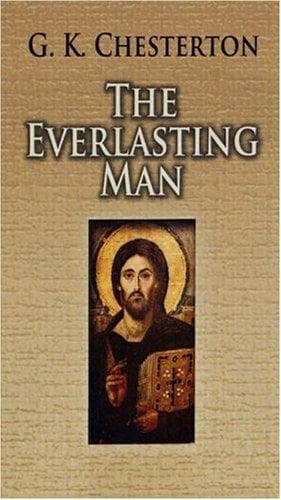
The Everlasting ManChesterton, G. K. (Gilbert Keith)
Religion
The Everlasting Man
Chesterton, G. K. (Gilbert Keith)
Catholic Church -- Apologetic works; Christianity and other religions; Religion
criticise this view do not seem to have any very clear notion of what a
decline from civilisation would be like. Heaven help them, it is likely
enough that they will soon find out. They seem to be content if cave-men
and cannibal islanders have some things in common, such as certain
particular implements. But it is obvious on the face of it that any
peoples reduced for any reason to a ruder life would have some things in
common. If we lost all our firearms we should make bows and arrows; but
we should not necessarily resemble in every way the first men who made
bows and arrows. It is said that the Russians in their great retreat
were so short of armament that they fought with clubs cut in the wood.
But a professor of the future would err in supposing that the Russian
Army of 1916 was a naked Scythian tribe that had never been out of the
wood. It is like saying that a man in his second childhood must exactly
copy his first. A baby is bald like an old man; but it would be an error
for one ignorant of infancy to infer that the baby had a long white
beard. Both a baby and an old man walk with difficulty; but he who shall
expect the old gentleman to lie on his back, and kick joyfully instead,
will be disappointed.
It is therefore absurd to argue that the first pioneers of humanity must
have been identical with some of the last and most stagnant leavings of
it. There were almost certainly some things, there were probably many
things, in which the two were widely different or flatly contrary. An
example of the way in which this distinction works, and an example
essential to our argument here, is that of the nature and origin of
government. I have already alluded to Mr. H. G. Wells and the Old Man,
with whom he appears to be on such intimate terms. If we considered the
cold facts of prehistoric evidence for this portrait of the prehistoric
chief of the tribe, we could only excuse it by saying that its brilliant
and versatile author simply forgot for a moment that he was supposed to
be writing a history, and dreamed he was writing one of his own very
wonderful and imaginative romances. At least I cannot imagine how he can
possibly know that the prehistoric ruler was called the Old Man or that
court etiquette requires it to be spelt with capital letters. He says of
the same potentate, ‘No one was allowed to touch his spear or to sit in
his seat.’ I have difficulty in believing that anybody has dug up a
prehistoric spear with a prehistoric label, ‘Visitors are Requested not
to Touch,’ or a complete throne with the inscription, ‘Reserved for the
Old Man.’ But it may be presumed that the writer, who can hardly be
supposed to be merely making up things out of his own head, was merely
taking for granted this very dubious parallel between the prehistoric
and the decivilised man. It may be that in certain savage tribes the
chief is called the Old Man and nobody is allowed to touch his spear or
sit on his seat. It may be that in those cases he is surrounded with
Public-domain text, read in full here on John Shaqi.
Reviews
Reviews
No reviews yet
Be the first to share your thoughts on this work.
Join the Discussion
Join the discussion
Sign in to leave a comment or review.
Sign InorCreate an account