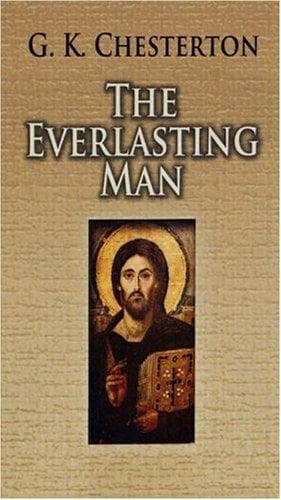
The Everlasting ManChesterton, G. K. (Gilbert Keith)
Religion
The Everlasting Man
Chesterton, G. K. (Gilbert Keith)
Catholic Church -- Apologetic works; Christianity and other religions; Religion
superstitious and traditional terrors; and it may be that in those
cases, for all I know, he is despotic and tyrannical. But there is not a
grain of evidence that primitive government was despotic and tyrannical.
It may have been, of course, for it may have been anything or even
nothing; it may not have existed at all. But the despotism in certain
dingy and decayed tribes in the twentieth century does not prove that
the first men were ruled despotically. It does not even suggest it; it
does not even begin to hint at it. If there is one fact we really can
prove, from the history that we really do know, it is that despotism can
be a development, often a late development and very often indeed the end
of societies that have been highly democratic. A despotism may almost be
defined as a tired democracy. As fatigue falls on a community, the
citizens are less inclined for that eternal vigilance which has truly
been called the price of liberty; and they prefer to arm only one single
sentinel to watch the city while they sleep. It is also true that they
sometimes needed him for some sudden and militant act of reform; it is
equally true that he often took advantage of being the strong man armed
to be a tyrant like some of the Sultans of the East. But I cannot see
why the Sultan should have appeared any earlier in history than many
other human figures. On the contrary, the strong man armed obviously
depends upon the superiority of his armour; and armament of that sort
comes with more complex civilisation. One man may kill twenty with a
machine-gun; it is obviously less likely that he could do it with a
piece of flint. As for the current cant about the strongest man ruling
by force and fear, it is simply a nursery fairy-tale about a giant with
a hundred hands. Twenty men could hold down the strongest strong man in
any society, ancient or modern. Undoubtedly they might _admire_, in a
romantic and poetical sense, the man who was really the strongest; but
that is quite a different thing, and is as purely moral and even
mystical as the admiration for the purest or the wisest. But the spirit
that endures the mere cruelties and caprices of an established despot is
the spirit of an ancient and settled and probably stiffened society, not
the spirit of a new one. As his name implies, the Old Man is the ruler
of an old humanity.
Public-domain text, read in full here on John Shaqi.
Reviews
Reviews
No reviews yet
Be the first to share your thoughts on this work.
Join the Discussion
Join the discussion
Sign in to leave a comment or review.
Sign InorCreate an account