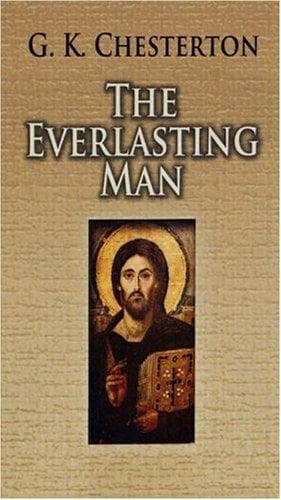
The Everlasting ManChesterton, G. K. (Gilbert Keith)
Religion
The Everlasting Man
Chesterton, G. K. (Gilbert Keith)
Catholic Church -- Apologetic works; Christianity and other religions; Religion
It may be said then that primitive government, like primitive art and
religion and everything else, is very imperfectly known or rather
guessed at; but that it is at least as good a guess to suggest that it
was as popular as a Balkan or Pyrenean village as that it was as
capricious and secret as a Turkish divan. Both the mountain democracy
and the oriental palace are modern in the sense that they are still
there, or are some sort of growth of history; but of the two the palace
has much more the look of being an accumulation and a corruption, the
village much more the look of being a really unchanged and primitive
thing. But my suggestions at this point do not go beyond expressing a
wholesome doubt about the current assumption. I think it interesting,
for instance, that liberal institutions have been traced even by
moderns back to barbarian or undeveloped states, when it happened to be
convenient for the support of some race or nation or philosophy. So the
Socialists profess that their ideal of communal property existed in very
early times. So the Jews are proud of the Jubilees or juster
redistributions under their ancient law. So the Teutonists boasted of
tracing parliaments and juries and various popular things among the
Germanic tribes of the North. So the Celtophiles and those testifying to
the wrongs of Ireland have pleaded the more equal justice of the clan
system, to which the Irish chiefs bore witness before Strongbow. The
strength of the case varies in the different cases; but as there is some
case for all of them, I suspect there is some case for the general
proposition that popular institutions of some sort were by no means
uncommon in early and simple societies. Each of these separate schools
were making the admission to prove a particular modern thesis; but taken
together they suggest a more ancient and general truth, that there was
something more in prehistoric councils than ferocity and fear. Each of
these separate theorists had his own axe to grind, but he was willing to
use a stone axe; and he manages to suggest that the stone axe might have
been as republican as the guillotine.
Public-domain text, read in full here on John Shaqi.
Reviews
Reviews
No reviews yet
Be the first to share your thoughts on this work.
Join the Discussion
Join the discussion
Sign in to leave a comment or review.
Sign InorCreate an account