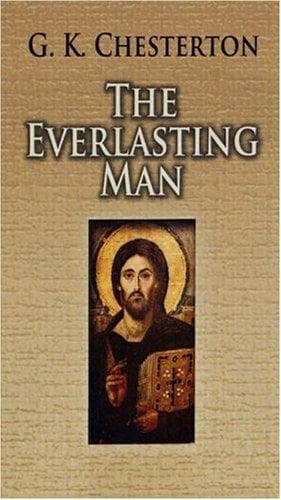
The Everlasting ManChesterton, G. K. (Gilbert Keith)
Religion
The Everlasting Man
Chesterton, G. K. (Gilbert Keith)
Catholic Church -- Apologetic works; Christianity and other religions; Religion
It is so also with the more special fancy about evolution and social
stability. According to the real records available, barbarism and
civilisation were not successive stages in the progress of the world.
They were conditions that existed side by side, as they still exist side
by side. There were civilisations then as there are civilisations now;
there are savages now as there were savages then. It is suggested that
all men passed through a nomadic stage; but it is certain that there are
some who have never passed out of it, and it seems not unlikely that
there were some who never passed into it. It is probable that from very
primitive times the static tiller of the soil and the wandering shepherd
were two distinct types of men; and the chronological rearrangement of
them is but a mark of that mania for progressive stages that has largely
falsified history. It is suggested that there was a communist stage, in
which private property was everywhere unknown, a whole humanity living
on the negation of property; but the evidences of this negation are
themselves rather negative. Redistributions of property, jubilees, and
agrarian laws occur at various intervals and in various forms; but that
humanity inevitably passed through a communist stage seems as doubtful
as the parallel proposition that humanity will inevitably return to it.
It is chiefly interesting as evidence that the boldest plans for the
future invoke the authority of the past; and that even a revolutionary
seeks to satisfy himself that he is also a reactionary. There is an
amusing parallel example in the case of what is called feminism. In
spite of all the pseudo-scientific gossip about marriage by capture and
the cave-man beating the cave-woman with a club, it may be noted that as
soon as feminism became a fashionable cry, it was insisted that human
civilisation in its first stage had been a matriarchy. Apparently it was
the cave-woman who carried the club. Anyhow all these ideas are little
better than guesses; and they have a curious way of following the
fortune of modern theories and fads. In any case they are not history in
the sense of record; and we may repeat that when it comes to record, the
broad truth is that barbarism and civilisation have always dwelt side by
side in the world, the civilisation sometimes spreading to absorb the
barbarians, sometimes decaying into relative barbarism, and in almost
all cases possessing in a more finished form certain ideas and
institutions which the barbarians possess in a ruder form; such as
government or social authority, the arts and especially the decorative
arts, mysteries and taboos of various kinds especially surrounding the
matter of sex, and some form of that fundamental thing which is the
chief concern of this inquiry: the thing that we call religion.
Public-domain text, read in full here on John Shaqi.
Reviews
Reviews
No reviews yet
Be the first to share your thoughts on this work.
Join the Discussion
Join the discussion
Sign in to leave a comment or review.
Sign InorCreate an account