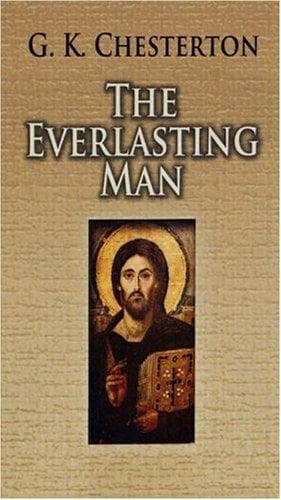
The Everlasting ManChesterton, G. K. (Gilbert Keith)
Religion
The Everlasting Man
Chesterton, G. K. (Gilbert Keith)
Catholic Church -- Apologetic works; Christianity and other religions; Religion
Egypt is a green ribbon along the river edging the dark red desolation
of the desert. It is a proverb, and one of vast antiquity, that it is
created by the mysterious bounty and almost sinister benevolence of the
Nile. When we first hear of Egyptians they are living as in a string of
river-side villages, in small and separate but co-operative communities
along the bank of the Nile. Where the river branched into the broad
Delta there was traditionally the beginning of a somewhat different
district or people; but this need not complicate the main truth. These
more or less independent though interdependent peoples were considerably
civilised already. They had a sort of heraldry; that is, decorative art
used for symbolic and social purposes; each sailing the Nile under its
own ensign representing some bird or animal. Heraldry involves two
things of enormous importance to normal humanity; the combination of the
two making that noble thing called co-operation; on which rest all
peasantries and peoples that are free. The art of heraldry means
independence; an image chosen by the imagination to express the
individuality. The science of heraldry means interdependence; an
agreement between different bodies to recognise different images; a
science of imagery. We have here therefore exactly that compromise of
co-operation between free families or groups which is the most normal
mode of life for humanity and is particularly apparent wherever men own
their own land and live on it. With the very mention of the images of
bird and beast the student of mythology will murmur the word ‘totem’
almost in his sleep. But to my mind much of the trouble arises from his
habit of saying such words as if in his sleep. Throughout this rough
outline I have made a necessarily inadequate attempt to keep on the
inside rather than the outside of such things; to consider them where
possible in terms of thought and not merely in terms of terminology.
There is very little value in talking about totems unless we have some
feeling of what it really felt like to have a totem. Granted that they
had totems and we have no totems; was it because they had more fear of
animals or more familiarity with animals? Did a man whose totem was a
wolf feel like a were-wolf or like a man running away from a were-wolf?
Did he feel like Uncle Remus about Brer Wolf or like St. Francis about
his brother the wolf, or like Mowgli about his brothers the wolves? Was
a totem a thing like the British lion or a thing like the British
bulldog? Was the worship of a totem like the feeling of niggers about
Mumbo Jumbo, or of children about Jumbo? I have never read any book of
folk-lore, however learned, that gave me any light upon this question,
which I think by far the most important one. I will confine myself to
repeating that the earliest Egyptian communities had a common
understanding about the images that stood for their individual states;
and that this amount of communication is prehistoric in the sense that
Public-domain text, read in full here on John Shaqi.
Reviews
Reviews
No reviews yet
Be the first to share your thoughts on this work.
Join the Discussion
Join the discussion
Sign in to leave a comment or review.
Sign InorCreate an account