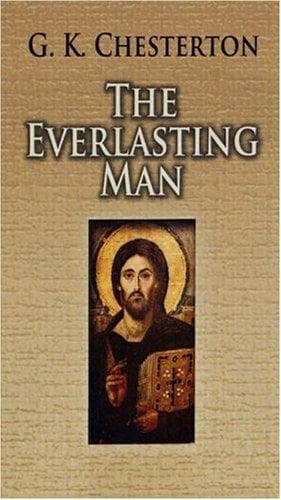
The Everlasting ManChesterton, G. K. (Gilbert Keith)
Religion
The Everlasting Man
Chesterton, G. K. (Gilbert Keith)
Catholic Church -- Apologetic works; Christianity and other religions; Religion
the sense that I should be ashamed to talk such nonsense about the Lama
of Thibet as they do about the Pope of Rome, or to have as little
sympathy with Julian the Apostate as they have with the Society of
Jesus. They are not impartial; they never by any chance hold the
historical scales even; and above all they are never impartial upon this
point of evolution and transition. They suggest everywhere the grey
gradations of twilight, because they believe it is the twilight of the
gods. I propose to maintain that whether or no it is the twilight of
gods, it is not the daylight of men.
I maintain that when brought out into the daylight, these two things
look altogether strange and unique; and that it is only in the false
twilight of an imaginary period of transition that they can be made to
look in the least like anything else. The first of these is the creature
called man, and the second is the man called Christ. I have therefore
divided this book into two parts: the former being a sketch of the main
adventure of the human race in so far as it remained heathen; and the
second a summary of the real difference that was made by it becoming
Christian. Both motives necessitate a certain method, a method which is
not very easy to manage, and perhaps even less easy to define or defend.
In order to strike, in the only sane or possible sense, the note of
impartiality, it is necessary to touch the nerve of novelty. I mean that
in one sense we see things fairly when we see them first. That, I may
remark in passing, is why children generally have very little difficulty
about the dogmas of the Church. But the Church, being a highly practical
thing for working and fighting, is necessarily a thing for men and not
merely for children. There must be in it for working purposes a great
deal of tradition, of familiarity, and even of routine. So long as its
fundamentals are sincerely felt, this may even be the saner condition.
But when its fundamentals are doubted, as at present, we must try to
recover the candour and wonder of the child; the unspoilt realism and
objectivity of innocence. Or if we cannot do that, we must try at least
to shake off the cloud of mere custom and see the thing as new, if only
by seeing it as unnatural. Things that may well be familiar so long as
familiarity breeds affection had much better become unfamiliar when
familiarity breeds contempt. For in connection with things so great as
are here considered, whatever our view of them, contempt must be a
mistake. Indeed contempt must be an illusion. We must invoke the most
wild and soaring sort of imagination; the imagination that can see what
is there.
Public-domain text, read in full here on John Shaqi.
Reviews
Reviews
No reviews yet
Be the first to share your thoughts on this work.
Join the Discussion
Join the discussion
Sign in to leave a comment or review.
Sign InorCreate an account