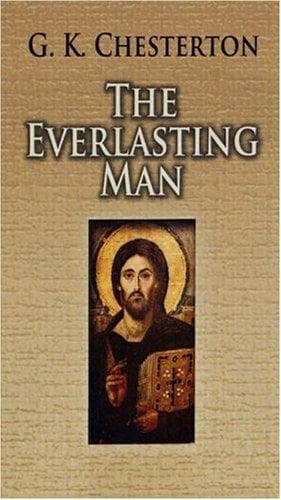
The Everlasting ManChesterton, G. K. (Gilbert Keith)
Religion
The Everlasting Man
Chesterton, G. K. (Gilbert Keith)
Catholic Church -- Apologetic works; Christianity and other religions; Religion
Christian saints as if they were Pagan sages.
But with this we come to the final and vital point. I shall try to show
in these pages that when we _do_ make this imaginative effort to see the
whole thing from the outside, we find that it really looks like what is
traditionally said about it inside. It is exactly when the boy gets far
enough off to see the giant that he sees that he really is a giant. It
is exactly when we do at last see the Christian Church afar under those
clear and level eastern skies that we see that it is really the Church
of Christ. To put it shortly, the moment we are really impartial about
it we know why people are partial to it. But this second proposition
requires more serious discussion; and I shall here set myself to discuss
it.
As soon as I had clearly in my mind this conception of something solid
in the solitary and unique character of the divine story, it struck me
that there was exactly the same strange and yet solid character in the
human story that had led up to it; because that human story also had a
root that was divine. I mean that just as the Church seems to grow more
remarkable when it is fairly compared with the common religious life of
mankind, so mankind itself seems to grow more remarkable when we compare
it with the common life of nature. And I have noticed that most modern
history is driven to something like sophistry, first to soften the sharp
transition from animals to men, and then to soften the sharp transition
from heathens to Christians. Now the more we really read in a realistic
spirit of those two transitions the sharper we shall find them to be. It
is because the critics are _not_ detached that they do not see this
detachment; it is because they are not looking at things in a dry light
that they cannot see the difference between black and white. It is
because they are in a particular mood of reaction and revolt that they
have a motive for making out that all the white is dirty grey and the
black not so black as it is painted. I do not say there are not human
excuses for their revolt; I do not say it is not in some ways
sympathetic; what I say is that it is not in any way scientific. An
iconoclast may be indignant; an iconoclast may be justly indignant; but
an iconoclast is not impartial. And it is stark hypocrisy to pretend
that nine-tenths of the higher critics and scientific evolutionists and
professors of comparative religion are in the least impartial. Why
should they be impartial, what is being impartial, when the whole world
is at war about whether one thing is a devouring superstition or a
divine hope? I do not pretend to be impartial in the sense that the
final act of faith fixes a man’s mind because it satisfies his mind. But
I do profess to be a great deal more impartial than they are; in the
sense that I can tell the story fairly, with some sort of imaginative
justice to all sides; and they cannot. I do profess to be impartial in
Public-domain text, read in full here on John Shaqi.
Reviews
Reviews
No reviews yet
Be the first to share your thoughts on this work.
Join the Discussion
Join the discussion
Sign in to leave a comment or review.
Sign InorCreate an account