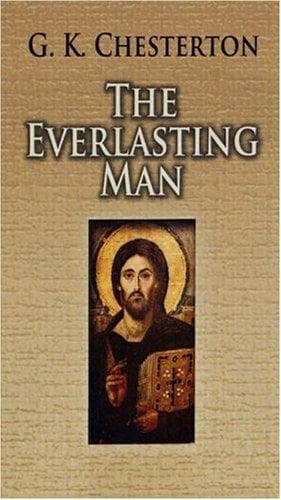
The Everlasting ManChesterton, G. K. (Gilbert Keith)
Religion
The Everlasting Man
Chesterton, G. K. (Gilbert Keith)
Catholic Church -- Apologetic works; Christianity and other religions; Religion
Somewhere along the Ionian coast opposite Crete and the islands was a
town of some sort, probably of the sort that we should call a village or
hamlet with a wall. It was called Ilion but it came to be called Troy,
and the name will never perish from the earth. A poet who may have been
a beggar and a balladmonger, who may have been unable to read and write,
and was described by tradition as blind, composed a poem about the
Greeks going to war with this town to recover the most beautiful woman
in the world. That the most beautiful woman in the world lived in that
one little town sounds like a legend; that the most beautiful poem in
the world was written by somebody who knew of nothing larger than such
little towns is a historical fact. It is said that the poem came at the
end of the period; that the primitive culture brought it forth in its
decay; in which case one would like to have seen that culture in its
prime. But anyhow it is true that this, which is our first poem, might
very well be our last poem too. It might well be the last word as well
as the first word spoken by man about his mortal lot, as seen by merely
mortal vision. If the world becomes pagan and perishes, the last man
left alive would do well to quote the Iliad and die.
But in this one great human revelation of antiquity there is another
element of great historical importance; which has hardly I think been
given its proper place in history. The poet has so conceived the poem
that his sympathies apparently, and those of his reader certainly, are
on the side of the vanquished rather than of the victor. And this is a
sentiment which increases in the poetical tradition even as the poetical
origin itself recedes. Achilles had some status as a sort of demigod in
pagan times; but he disappears altogether in later times. But Hector
grows greater as the ages pass; and it is his name that is the name of a
Knight of the Round Table and his sword that legend puts into the hand
of Roland, laying about him with the weapon of the defeated Hector in
the last ruin and splendour of his own defeat. The name anticipates all
the defeats through which our race and religion were to pass; that
survival of a hundred defeats that is its triumph.
Public-domain text, read in full here on John Shaqi.
Reviews
Reviews
No reviews yet
Be the first to share your thoughts on this work.
Elsewhere in the archive
Join the Discussion
Join the discussion
Sign in to leave a comment or review.
Sign InorCreate an account