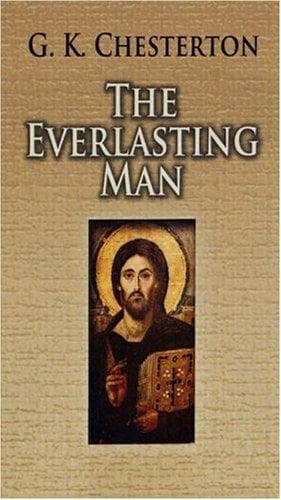
The Everlasting ManChesterton, G. K. (Gilbert Keith)
Religion
The Everlasting Man
Chesterton, G. K. (Gilbert Keith)
Catholic Church -- Apologetic works; Christianity and other religions; Religion
would mean, among other things, this banishment of the first
fatherhood. There is the idea of God in the very notion that there were
gods before the gods. There is an idea of greater simplicity in all the
allusions to that more ancient order. The suggestion is supported by the
process of propagation we see in historic times. Gods and demigods and
heroes breed like herrings before our very eyes, and suggest of
themselves that the family may have had one founder; mythology grows
more and more complicated, and the very complication suggests that at
the beginning it was more simple. Even on the external evidence, of the
sort called scientific, there is therefore a very good case for the
suggestion that man began with monotheism before it developed or
degenerated into polytheism. But I am concerned rather with an internal
than an external truth; and, as I have already said, the internal truth
is almost indescribable. We have to speak of something of which it is
the whole point that people did not speak of it; we have not merely to
translate from a strange tongue or speech, but from a strange silence.
I suspect an immense implication behind all polytheism and paganism. I
suspect we have only a hint of it here and there in these savage creeds
or Greek origins. It is not exactly what we mean by the presence of God;
in a sense it might more truly be called the absence of God. But absence
does not mean non-existence; and a man drinking the toast of absent
friends does not mean that from his life all friendship is absent. It is
a void but it is not a negation; it is something as positive as an empty
chair. It would be an exaggeration to say that the pagan saw higher than
Olympus an empty throne. It would be nearer the truth to take the
gigantic imagery of the Old Testament, in which the prophet saw God from
behind; it was as if some immeasurable presence had turned its back on
the world. Yet the meaning will again be missed if it is supposed to be
anything so conscious and vivid as the monotheism of Moses and his
people. I do not mean that the pagan peoples were in the least
overpowered by this idea merely because it is overpowering. On the
contrary, it was so large that they all carried it lightly, as we all
carry the load of the sky. Gazing at some detail like a bird or a cloud,
we can all ignore its awful blue background; we can neglect the sky; and
precisely because it bears down upon us with an annihilating force, it
is felt as nothing. A thing of this kind can only be an impression and a
rather subtle impression; but to me it is a very strong impression made
by pagan literature and religion. I repeat that in our special
sacramental sense there is, of course, the absence of the presence of
God. But there is in a very real sense the presence of the absence of
God. We feel it in the unfathomable sadness of pagan poetry; for I doubt
if there was ever in all the marvellous manhood of antiquity a man who
was happy as St. Francis was happy.
Public-domain text, read in full here on John Shaqi.
Reviews
Reviews
No reviews yet
Be the first to share your thoughts on this work.
Elsewhere in the archive
Join the Discussion
Join the discussion
Sign in to leave a comment or review.
Sign InorCreate an account