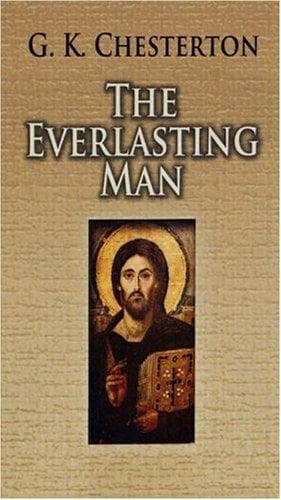
The Everlasting ManChesterton, G. K. (Gilbert Keith)
Religion
The Everlasting Man
Chesterton, G. K. (Gilbert Keith)
Catholic Church -- Apologetic works; Christianity and other religions; Religion
We feel it in the legend of a Golden
Age and again in the vague implication that the gods themselves are
ultimately related to something else, even when that Unknown God has
faded into a Fate. Above all we feel it in those immortal moments when
the pagan literature seems to return to a more innocent antiquity and
speak with a more direct voice, so that no word is worthy of it except
our own monotheistic monosyllable. We cannot say anything but ‘God’ in a
sentence like that of Socrates bidding farewell to his judges: ‘I go to
die and you remain to live; and God alone knows which of us goes the
better way.’ We can use no other word even for the best moments of
Marcus Aurelius: ‘Can they say dear city of Cecrops, and canst thou not
say dear city of God?’ We can use no other word in that mighty line in
which Virgil spoke to all who suffer with the veritable cry of a
Christian before Christ, in the untranslatable: ‘O passi graviora dabit
deus his quoque finem.’
In short, there is a feeling that there is something higher than the
gods; but because it is higher it is also further away. Not yet could
even Virgil have read the riddle and the paradox of that other divinity,
who is both higher and nearer. For them what was truly divine was very
distant, so distant that they dismissed it more and more from their
minds. It had less and less to do with the mere mythology of which I
shall write later. Yet even in this there was a sort of tacit admission
of its intangible purity, when we consider what most of the mythology is
like. As the Jews would not degrade it by images, so the Greeks did not
degrade it even by imaginations. When the gods were more and more
remembered only by pranks and profligacies, it was relatively a movement
of reverence. It was an act of piety to forget God. In other words,
there is something in the whole tone of the time suggesting that men had
accepted a lower level, and still were half conscious that it was a
lower level. It is hard to find words for these things; yet the one
really just word stands ready. These men were conscious of the Fall, if
they were conscious of nothing else; and the same is true of all heathen
humanity. Those who have fallen may remember the fall, even when they
forget the height. Some such tantalising blank or break in memory is at
the back of all pagan sentiment. There is such a thing as the momentary
power to remember that we forget. And the most ignorant of humanity know
by the very look of earth that they have forgotten heaven. But it
remains true that even for these men there were moments, like the
memories of childhood, when they heard themselves talking with a simpler
language; there were moments when the Roman, like Virgil in the line
already quoted, cut his way with a sword-stroke of song out of the
tangle of the mythologies; the motley mob of gods and goddesses sank
suddenly out of sight and the Sky-Father was alone in the sky.
Public-domain text, read in full here on John Shaqi.
Reviews
Reviews
No reviews yet
Be the first to share your thoughts on this work.
Elsewhere in the archive
Join the Discussion
Join the discussion
Sign in to leave a comment or review.
Sign InorCreate an account