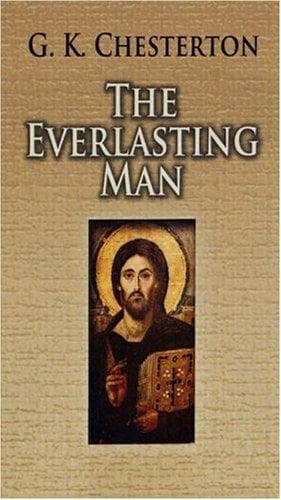
The Everlasting ManChesterton, G. K. (Gilbert Keith)
Religion
The Everlasting Man
Chesterton, G. K. (Gilbert Keith)
Catholic Church -- Apologetic works; Christianity and other religions; Religion
This latter example is very relevant to the next step in the process. A
white light as of a lost morning still lingers on the figure of Jupiter,
of Pan, or of the elder Apollo; and it may well be, as already noted,
that each was once a divinity as solitary as Jehovah or Allah. They lost
this lonely universality by a process it is here very necessary to note;
a process of amalgamation very like what was afterwards called
syncretism. The whole pagan world set itself to build a Pantheon. They
admitted more and more gods, gods not only of the Greeks but of the
barbarians; gods not only of Europe but of Asia and Africa. The more the
merrier, though some of the Asian and African ones were not very merry.
They admitted them to equal thrones with their own; sometimes they
identified them with their own. They may have regarded it as an
enrichment of their religious life; but it meant the final loss of all
that we now call religion. It meant that ancient light of simplicity,
that had a single source like the sun, finally fades away in a dazzle of
conflicting lights and colours. God is really sacrificed to the gods; in
a very literal sense of the flippant phrase, they have been too many for
him.
Polytheism, therefore, was really a sort of pool; in the sense of the
pagans having consented to the pooling of their pagan religions. And
this point is very important in many controversies ancient and modern.
It is regarded as a liberal and enlightened thing to say that the god of
the stranger may be as good as our own; and doubtless the pagans thought
themselves very liberal and enlightened when they agreed to add to the
gods of the city or the hearth some wild and fantastic Dionysus coming
down from the mountains or some shaggy and rustic Pan creeping out of
the woods. But exactly what it lost by these larger ideas is the largest
idea of all. It is the idea of the fatherhood that makes the whole
world one. And the converse is also true. Doubtless those more
antiquated men of antiquity who clung to their solitary statues and
their single sacred names were regarded as superstitious savages
benighted and left behind. But these superstitious savages were
preserving something that is much more like the cosmic power as
conceived by philosophy, or even as conceived by science. This paradox
by which the rude reactionary was a sort of prophetic progressive has
one consequence very much to the point. In a purely historical sense,
and apart from any other controversies in the same connection, it throws
a light, a single and a steady light, that shines from the beginning on
a little and lonely people. In this paradox, as in some riddle of
religion of which the answer was sealed up for centuries, lies the
mission and the meaning of the Jews.
Public-domain text, read in full here on John Shaqi.
Reviews
Reviews
No reviews yet
Be the first to share your thoughts on this work.
Elsewhere in the archive
Join the Discussion
Join the discussion
Sign in to leave a comment or review.
Sign InorCreate an account