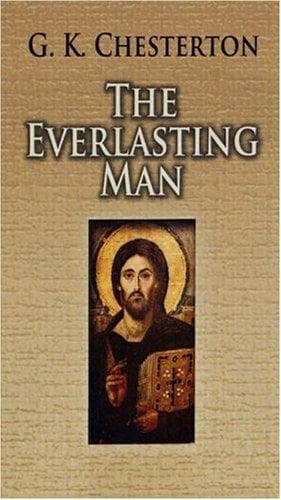
The Everlasting ManChesterton, G. K. (Gilbert Keith)
Religion
The Everlasting Man
Chesterton, G. K. (Gilbert Keith)
Catholic Church -- Apologetic works; Christianity and other religions; Religion
It is true in this sense, humanly speaking, that the world owes God to
the Jews. It owes that truth to much that is blamed in the Jews,
possibly to much that is blameable in the Jews. We have already noted
the nomadic position of the Jews amid the other pastoral peoples upon
the fringe of the Babylonian Empire, and something of that strange
erratic course of theirs blazed across the dark territory of extreme
antiquity, as they passed from the seat of Abraham and the shepherd
princes into Egypt and doubled back into the Palestinian hills and held
them against the Philistines from Crete and fell into captivity in
Babylon; and yet again returned to their mountain city by the Zionist
policy of the Persian conquerors; and so continued that amazing romance
of restlessness of which we have not yet seen the end. But through all
their wanderings, and especially through all their early wanderings,
they did indeed carry the fate of the world in that wooden tabernacle,
that held perhaps a featureless symbol and certainly an invisible god.
We may say that one most essential feature was that it was featureless.
Much as we may prefer that creative liberty which the Christian culture
has declared and by which it has eclipsed even the arts of antiquity, we
must not underrate the determining importance at the time of the Hebrew
inhibition of images. It is a typical example of one of those
limitations that did in fact preserve and perpetuate enlargement, like a
wall built round a wide open space. The God who could not have a statue
remained a spirit. Nor would his statue in any case have had the
disarming dignity and grace of the Greek statues then or the Christian
statues afterwards. He was living in a land of monsters. We shall have
occasion to consider more fully what those monsters were, Moloch and
Dagon and Tanit the terrible goddess. If the deity of Israel had ever
had an image, he would have had a phallic image. By merely giving him a
body they would have brought in all the worst elements of mythology; all
the polygamy of polytheism; the vision of the harem in heaven. This
point about the refusal of art is the first example of the limitations
which are often adversely criticised, only because the critics
themselves are limited. But an even stronger case can be found in the
other criticism offered by the same critics. It is often said with a
sneer that the God of Israel was only a God of Battles, ‘a mere barbaric
Lord of Hosts’ pitted in rivalry against other gods only as their
envious foe. Well it is for the world that he was a God of Battles. Well
it is for us that he was to all the rest only a rival and a foe. In the
ordinary way, it would have been only too easy for them to have achieved
the desolate disaster of conceiving him as a friend. It would have been
only too easy for them to have seen him stretching out his hands in love
and reconciliation, embracing Baal and kissing the painted face of
Public-domain text, read in full here on John Shaqi.
Reviews
Reviews
No reviews yet
Be the first to share your thoughts on this work.
Elsewhere in the archive
Join the Discussion
Join the discussion
Sign in to leave a comment or review.
Sign InorCreate an account