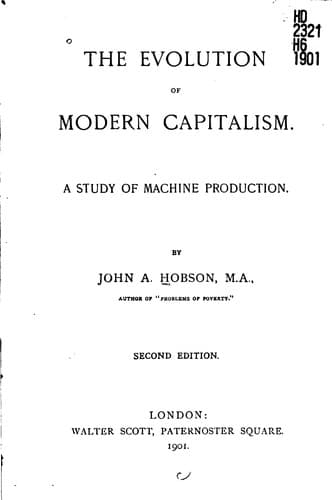
The Evolution of Modern Capitalism: A Study of Machine ProductionHobson, J. A. (John Atkinson)
History
The Evolution of Modern Capitalism: A Study of Machine Production
Hobson, J. A. (John Atkinson)
Capitalism; Industries -- History; Machinery in the workplace
Here we see a Trust exercising its economic power of regulating
production. That power, as we shall see below, is not merely confined
to closing the inferior mills in order that the same aggregate output
may be obtained by a full working of the more efficient plant. Where
over-production has occurred it is to the interest of the Trust to
lessen production. With this end in view it will suddenly close half
the mills, or works, or elevators in a district. The owners of these
closed plants get their interest from the Trust just as if they were
working. But the labour of these works suddenly, and without any
compensation for disturbance, is "saved"--that is to say, the
employees are deprived of the services of the only kind of plant and
material to which their skilled efforts are applicable. It is probable
that one result of the formation of each of these larger trusts has
been to throw out of employment several thousands of workers, and to
place them either in the ranks of the unemployed or in some other
branch of industry where their previously acquired skill is of little
service, and where their wages are correspondingly depressed. From the
account given above of the changes in organisation of production under
the Trust it might appear that the effect upon labour was not to
reduce the net employment, but to give full, regular employment to a
smaller number instead of partial and irregular employment to many,
and that thus labour, considered as a whole, might be the gainer. An
industrial movement which substitutes the regular employment of a few
for the irregular employment of many is so far a progressive movement.
But it must be borne in mind first that there is usually a net
reduction of employment, a substitution not of 50 workers at full-time
for 100 at half-time, but of 30 only. For not only will there be a
net saving of labour in relation to the same output, the result of
using exclusively the best equipped and best situated factories, but
since the Trust came into existence in order to restrict production
and so raise prices, the aggregate output of the business will be
either reduced or its rate of increase will be less than under open
competition. The chief economy of the Trust will in fact arise from
the net diminution of employment of labour. As the Trust grows
stronger and absorbs a larger and larger proportion of the total
supply for the market, the reduction of employment will as a rule
continue. Of course, if the scale of prices which the Trust finds most
profitable happens to be such as induce a large increase of
consumption, and therefore to permit an expansion of the machinery of
production, the aggregate of employment may be maintained or even
increased. But, as we shall see below, there is nothing in the nature
of a Trust to guarantee such a result. The normal result of placing
the ordering of an industry in the hands of a monopoly company is to
give them a power which it is their interest to exercise, to narrow
Public-domain text, read in full here on John Shaqi.
Reviews
Reviews
No reviews yet
Be the first to share your thoughts on this work.
Elsewhere in the archive
Join the Discussion
Join the discussion
Sign in to leave a comment or review.
Sign InorCreate an account