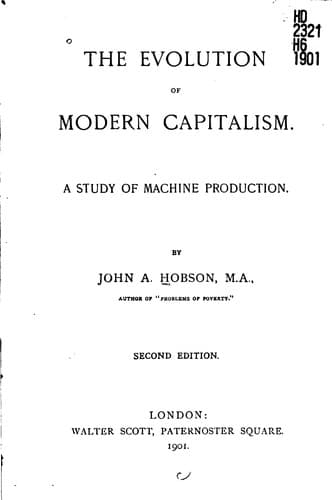
The Evolution of Modern Capitalism: A Study of Machine ProductionHobson, J. A. (John Atkinson)
History
The Evolution of Modern Capitalism: A Study of Machine Production
Hobson, J. A. (John Atkinson)
Capitalism; Industries -- History; Machinery in the workplace
§ 1. _Dimensions of International Commerce in early Eighteenth
Century._
§ 2. _Natural Barriers to International Trade._
§ 3. _Political, Pseudo-economic, and Economic Barriers--
Protective Theory and Practice._
§ 4. _Nature of International Trade._
§ 5. _Size, Structure, Relations of the several Industries._
§ 6. _Slight Extent of Local Specialisation._
§ 7. _Nature and Conditions of Specialised Industry._
§ 8. _Structure of the Market._
§ 9. _Combined Agriculture and Manufacture._
§ 10. _Relations between Processes in a Manufacture._
§ 11. _Structure of the Domestic Business: Early Stages of
Transition._
§ 12. _Beginnings of Concentrated Industry and the Factory._
§ 13. _Limitations in Size and Application of Capital--
Merchant Capitalism._
§ 1. In order to get some clear understanding of the laws of the
operation of the new industrial forces which prevail under
machine-production it is first essential to know rightly the structure
and functional character of the "industrial organism" upon which they
were destined to act. In order to build up a clear conception of
industry it is possible to take either of two modes of inquiry. Taking
as the primary cell or unit that combination of labour and capital
under a single control for a single industrial purpose which is termed
a Business, we may examine the structure and life of the Business,
then proceed to discover how it stands related to other businesses so
as to form a Market, and, finally, how the several Markets are
related locally, nationally, internationally so as to yield the
complex structure of Industry as a whole. Or reversely, we may take
Industry as a whole, the Industrial Organism as it exists at any given
time, consider the nature and extent of the cohesion existing between
its several parts, and, further, resolving these parts into their
constituent elements, gain a close understanding of the extent to
which differentiation of industrial functions has been carried in the
several divisions.
Although in any sociological inquiry these two methods are equally
valid, or, more strictly speaking, are equally balanced in virtues and
defects, the latter method is here to be preferred, because by the
order of its descent from the whole to the constituent parts it brings
out more definitely the slight cohesiveness and integration of
industry beyond the national limits, and serves to emphasise those
qualities of nationalism and narrow localism which mark the character
of earlier eighteenth century industry. We are thus enabled better to
recognise the nature and scope of the work wrought by the modern
industrial forces which are the central object of study.
Public-domain text, read in full here on John Shaqi.
Reviews
Reviews
No reviews yet
Be the first to share your thoughts on this work.
Join the Discussion
Join the discussion
Sign in to leave a comment or review.
Sign InorCreate an account