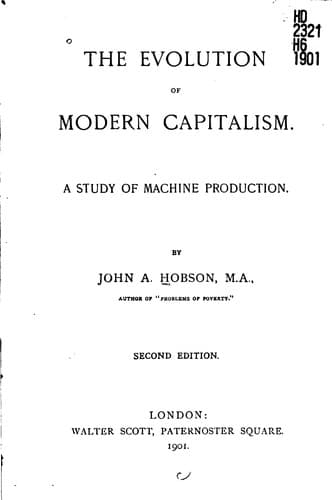
The Evolution of Modern Capitalism: A Study of Machine Production — John Shaqi
The Evolution of Modern Capitalism: A Study of Machine ProductionHobson, J. A. (John Atkinson)
History
The Evolution of Modern Capitalism: A Study of Machine Production
Hobson, J. A. (John Atkinson)
Capitalism; Industries -- History; Machinery in the workplace
While the Market or the Trade is less and less determined or confined
by national or other political boundaries in modern times, and
nationalism is therefore a factor of diminishing importance in the
modern science of economics, the paramount domination of politics over
large commerce in the last century, acting in co-operation with other
racial and national forces, obliges any just analysis of eighteenth
century industry to give clear and early emphasis to the slight
character of the commercial interdependency among nations. The degree
of importance which statesmen and economists attached to this foreign
commerce as compared with home trade, and the large part it played in
the discussion and determination of public conduct, have given it a
prominence in written history far beyond its real value.[3]
It is true that through the Middle Ages a succession of European
nations rose to eminence by the development of navigation and
international trade, Italy, Portugal, Spain, France, Holland, and
England; but neither in size nor in character was this trade of the
first importance. Even in the case of those nations where it was most
developed it formed a very small proportion of the total industry of
the country, and it was chiefly confined to spicery, bullion,
ornamental cloths, and other objects of art and luxury.
It is important to recognise that in the first half of the eighteenth
century international trade still largely partook of this character.
Not only did it bear a far smaller proportion to the total industry of
the several countries than does foreign trade to-day, but it was still
engaged to a comparatively small extent with the transport of
necessaries or prime conveniences of life. Each nation, as regards the
more important constituents of its consumption, its staple foods,
articles of clothing, household furniture, and the chief implements of
industry, was almost self-sufficing, producing little that it did not
consume, consuming little it did not produce.
Public-domain text, read in full here on John Shaqi.
Reviews
Reviews
No reviews yet
Be the first to share your thoughts on this work.
Join the Discussion
Join the discussion
Sign in to leave a comment or review.
Sign InorCreate an account