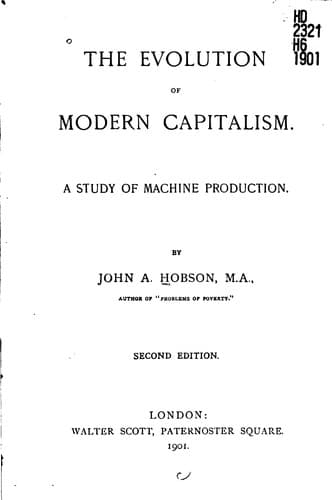
The Evolution of Modern Capitalism: A Study of Machine Production — John Shaqi
The Evolution of Modern Capitalism: A Study of Machine ProductionHobson, J. A. (John Atkinson)
History
The Evolution of Modern Capitalism: A Study of Machine Production
Hobson, J. A. (John Atkinson)
Capitalism; Industries -- History; Machinery in the workplace
Though considerable advances had been made by England and Holland at
the beginning of the eighteenth century in the improvement of
harbours, the establishment of lighthouses, and the development of
marine insurance,[8] navigation was still subject to considerable
risks of the loss of life and of investments, while these "natural"
dangers were increased by the prevalence of piracy. Voyages were slow
and expensive, commerce between distant nations being necessarily
confined to goods of a less perishable character which would stand the
voyage. Trade in fresh foods, which forms so large a part of modern
commerce, would have been impossible except along the coasts of
adjoining nations. With these natural barriers to commerce may be
reckoned the defective knowledge of the position, resources, and
requirements of large parts of the earth which now fill an important
place in commerce. The new world was but slightly opened up, nor could
its known resources be largely utilised before the development of more
adequate machinery of transport. We can scarcely realise the
inconveniences, costs, and risks entailed by the more distant branches
of foreign trade at a time when the captain of a merchant-ship still
freighted his vessel at his own expense, and when each voyage was a
separate speculation. Even in the early nineteenth century the
manufacturer commonly shipped his surplus produce at his own risk,
employing the merchant upon commission, and in the trade with the
Indies, China, or South America he had frequently to lie out of his
money or his return freight of indigo, coffee, tea, etc., for as long
as eighteen months or two years, and to bear the expense of
warehousing as well as the damage which time and tide inflicted on his
goods.
§ 3. Next come a series of barriers, partly political, partly
pseudo-economic, in which the antagonism of nations took shape, the
formation of political and industrial theories which directed the
commercial intercourse of nations into certain narrow and definite
channels.
Public-domain text, read in full here on John Shaqi.
Reviews
Reviews
No reviews yet
Be the first to share your thoughts on this work.
Join the Discussion
Join the discussion
Sign in to leave a comment or review.
Sign InorCreate an account