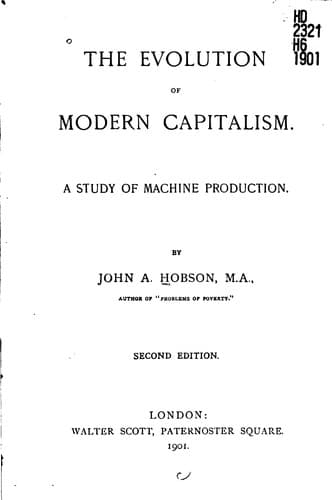
The Evolution of Modern Capitalism: A Study of Machine Production — John Shaqi
The Evolution of Modern Capitalism: A Study of Machine ProductionHobson, J. A. (John Atkinson)
History
The Evolution of Modern Capitalism: A Study of Machine Production
Hobson, J. A. (John Atkinson)
Capitalism; Industries -- History; Machinery in the workplace
Two economic doctrines, separate in the world of false ideas, though
their joint application in the world of practice has led many to
confuse them, exercised a dominant influence in diminishing the
quantity, and determining the quality of international trade in the
eighteenth century. These doctrines had reference respectively to the
construction and maintenance of home industries and the balance of
trade. The former doctrine, which was not so much a consciously-evolved
theory as a short-sighted, intellectual assumption driven by the urgent
impulse of vested interests into practical effect, taught that, on the
one hand, import trade should be restricted to commodities which were
not and could not with advantage be produced at home, and to the
provision of cheap materials for existing manufactures; while export
trade, on the other hand, should be generally encouraged by a system of
bounties and drawbacks. This doctrine was first rigidly applied by the
French minister, Colbert, but the policy of France was faithfully
copied by England and other commercial nations and ranked as an
orthodox theory of international trade.
The Balance of Trade doctrine estimated the worth of a nation's
intercourse with another by the excess of the export over the import
trade, which brought a quantity of bullion into the exporting country.
This theory was also widely spread, though obviously its general
application would have been destructive of all international commerce.
The more liberal interpretation of the doctrine was satisfied with a
favourable balance of the aggregate export over the aggregate import
trade of the country, but the stricter interpretation, generally
dominant in practice, required that in the case of each particular
nation the balance should be favourable. In regarding England's
commerce with a foreign nation, any excess in import values over
export was spoken of as "a loss to England." England deliberately cut
off all trade with France during the period 1702 to 1763 by a system
of prohibitive tariffs urged by a double dread lest the balance should
be against us, and lest French textile goods might successfully
compete with English goods in the home markets. On the other hand, we
cultivated trade with Portugal because "we gain a greater balance from
Portugal than from any other country whatever." The practical policy
prevalent in 1713 is thus summarised by one of its enthusiastic
upholders--"We suffer the goods and merchandises of Holland, Germany,
Portugal, and Italy to be imported and consumed among us; and it is
well we do, for we expect a much greater value of our own to those
countries than we take from them. So that the consumption of those
nations pays much greater sums to the rents of our lands and the
labour of our people than ours does to theirs. But we keep out as much
as possible the goods and merchandises of France, because our
consumption of theirs would very much hinder the consumption of our
Public-domain text, read in full here on John Shaqi.
Reviews
Reviews
No reviews yet
Be the first to share your thoughts on this work.
Join the Discussion
Join the discussion
Sign in to leave a comment or review.
Sign InorCreate an account