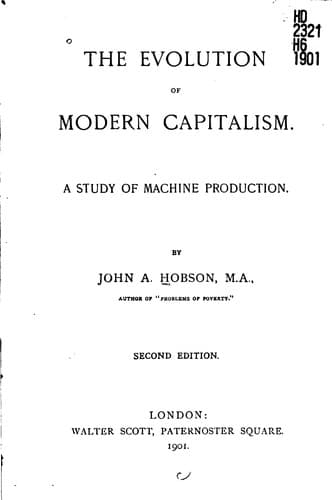
The Evolution of Modern Capitalism: A Study of Machine ProductionHobson, J. A. (John Atkinson)
History
The Evolution of Modern Capitalism: A Study of Machine Production
Hobson, J. A. (John Atkinson)
Capitalism; Industries -- History; Machinery in the workplace
Now, precisely the same line of reasoning applies if for the
individual A we take the country of the United States. If it tries to
increase its factories, machinery, etc., in excess of its ability to
pay, it can only do so by borrowing from other countries; and if it
cannot pay the interest on such loans, the "savings," in the shape of
fixed capital which it has endeavoured to secure for itself, remain
the property of the other countries which have effected the real
saving which they embody, assuming them to have a value. If the action
of the United States be called over-consumption, it is balanced by an
under-consumption of England, France, or other countries of the
commercial community. Mr. Price sought to avoid this conclusion by
saying nothing about the individual from whom the landowner or the
country from which the United States borrowed in order to increase the
fixed capital. But as the landowner and the United States, _ex
hypothesi_, did not make their improvements out of their own savings,
they made them out of somebody else's savings, and that conduct which
is styled over-consumption in them is balanced by an equal quantity of
under-consumption in some other party. If thus we look at the
individual landowner or the single country of the United States, we
might say, accepting Price's view of consumption, that he and it were
guilty of over-consumption, and that this was the cause of the
commercial crisis. But since this over-consumption is absolutely
conditioned by a correspondent under-consumption of some other member
of the industrial community, it is not possible to conclude with
Professor Price that over-consumption can even for a time exist in the
community as a whole, or that such a condition can be the explanation
of a crisis commonly felt by all or most of the members of that
community.
What actually happened in the case of United States railways was that
a number of people, either in America or in Europe, under-consumed or
over-saved: their excessive saving could find no better form to take
than American railways, which, _ex hypothesi_, were not wanted for
use. A number of persons who might have made and consumed three
hundred million pounds' worth more of corn, clothing, coals, etc.,
than they actually did consume, refused to do so, and instead of doing
so made a number of railway lines, locomotives, etc., which no one
could consume and which were not wanted to assist production. What
occurred was a waste of saving power through an attempt to make an
excessive number of forms of capital.
Even if, some years later, many of these forms obtained a use and a
value, none the less they represent an excess or waste of "saving" to
an extent measured by the normal rate of interest over that period of
time which elapsed before they fructified into use. In a word, what
had happened was not over-consumption, but under-consumption.
Public-domain text, read in full here on John Shaqi.
Reviews
Reviews
No reviews yet
Be the first to share your thoughts on this work.
Elsewhere in the archive
Join the Discussion
Join the discussion
Sign in to leave a comment or review.
Sign InorCreate an account