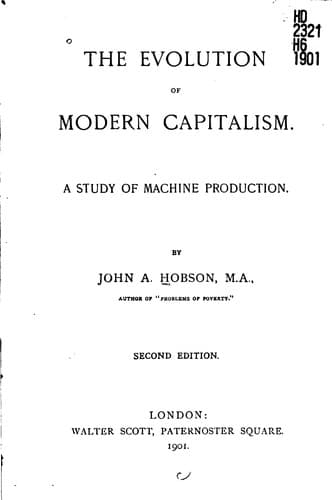
The Evolution of Modern Capitalism: A Study of Machine ProductionHobson, J. A. (John Atkinson)
History
The Evolution of Modern Capitalism: A Study of Machine Production
Hobson, J. A. (John Atkinson)
Capitalism; Industries -- History; Machinery in the workplace
M. Guyot appears to think that in the community as a whole too much
saving can be put into the form of "fixed" capital and too little into
circulating capital, and that such a condition of affairs will bring
depression. "Fixed capital," he says, "cannot be utilised if there is
no available circulating capital. Ships and railways are useless if
there are no commodities for them to convey; a factory cannot be
worked unless there are consumers ready to buy its products. If, then,
circulating capital has been so far exhausted as to take a long time
replacing, fixed capital must meanwhile remain unproductive, and the
crisis is so much the longer and more severe."[173]
To this there are two sufficient answers. The prevalence of low prices
for goods of various kinds as well as for plant in a time of
depression, the general glut of goods which forms one phase of the
depression proves that the crisis does not arise from storing too much
saving in plant and too little in goods. Where there exists
simultaneously a larger quantity of plant, raw material, finished
goods, and labour than the industrial society can find use for, no
assertion of maladjustment, either as between trade and trade, country
and country, fixed and circulating capital, will afford any
explanation. Secondly, M. Guyot gives away his entire position by
admitting "a factory cannot be worked unless there are consumers ready
to buy its products." A "consumer" here can logically only mean one
who buys finished goods for personal use, and if this be generally
applied it amounts to a clear admission that under-consumption is the
reason why there appears to be a glut of capital, fixed or other.
FOOTNOTES:
[146] _Contemporary Review_, March 1888.
[147] _Report on Industrial Depressions_, Washington, 1886.
[148] Report, pars. 61-66.
[149] Report, par. 106.
[150] _Contemporary Review_, July 1887.
[151] _Contemporary Review_, March 1888.
[152] _Report of the Commissioner of Labour_, Washington, 1886, pp. 80
to 88.
[153] D.A. Wells, _Contemporary Review_, August 1887.
[154] Lord Playfair, in the _Contemporary Review_, March 1888, gives a
number of interesting illustrations of recent economies in transport
and manufacture.
[155] _Statist_, 1879, quoted Bowley, _England's Foreign Trade in the
Nineteenth Century_, p. 80.
[156] _Essays in Finance_, vol. i. p. 137, etc.
[157] For the view that over-consumption is cause, see Appendix II.
[158] "What is annually saved is as regularly consumed as what is
annually spent, and nearly in the same time too; but it is consumed by
a different set of people." (_Wealth of Nations_, p. 149_b_,
McCulloch.) "Everything which is produced is consumed; both what is
saved and what is said to be spent, and the former quite as quickly as
the latter." (_Principles of Political Economy_, Book I., chap. v.,
sec. 6.)
[159] An able analysis of the nature of "paper savings" is found in
Mr. J.M. Robertson's _Fallacy of Saving_. (Sonnenschein.)
Public-domain text, read in full here on John Shaqi.
Reviews
Reviews
No reviews yet
Be the first to share your thoughts on this work.
Elsewhere in the archive
Join the Discussion
Join the discussion
Sign in to leave a comment or review.
Sign InorCreate an account