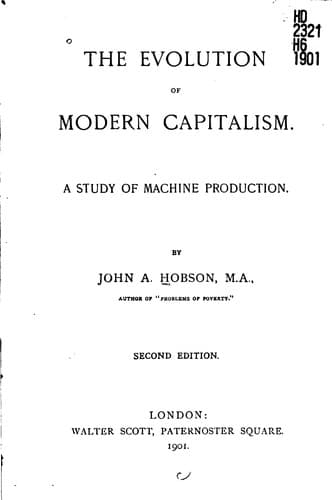
The Evolution of Modern Capitalism: A Study of Machine ProductionHobson, J. A. (John Atkinson)
History
The Evolution of Modern Capitalism: A Study of Machine Production
Hobson, J. A. (John Atkinson)
Capitalism; Industries -- History; Machinery in the workplace
own, and abate a great part of forty-two millions which it now pays to
the rents of our lands and the labour of our people."[9] Thus our
policy was to confine our import trade to foreign luxuries and raw
materials of manufacture which could not be here produced, drawn
exclusively from countries where such trade would not turn the balance
against us, and, on the other hand, to force our export trade on any
country that would receive it. Since every European nation was largely
influenced by similar ideas and motives, and enforced upon their
colonies and dependencies a like line of conduct, many mutually
profitable exchanges were prevented, and commerce was confined to
certain narrow and artificial grooves, while the national industrial
energy was wasted in the production of many things at home which could
have been more cheaply obtained from foreign countries through
exchange.
The following example may suffice to illustrate the intricacy of the
legislation passed in pursuance of this policy. It describes a change
of detailed policy in support and regulation of textile trade:--
"A tax was laid on foreign linens in order to provide a fund for
raising hemp and flax at home; while bounties were given on these
necessary articles from our colonies, the bounty on the exportation of
hemp was withdrawn. The imposts on foreign linen yarn were withdrawn.
Bounties were given on British linen cloth exported; while the making
of cambricks was promoted, partly by prohibiting the foreign and
partly by giving fresh incentives, though without success, to the
manufacture of cambricks within our island. Indigo, cochineal, and
logwood, the necessaries of dyes, were allowed to be freely
imported."[10]
The encouragement of English shipping (partly for commercial, partly
for political reasons) took elaborate shape in the Navigation Acts,
designed to secure for English vessels a monopoly of the carrying
trade between England and all other countries which sent goods to
English or to colonial shores. This policy was supported by a network
of minor measures giving bounties to our colonies for the exportation
of shipping materials, pitch, tar, hemp, turpentine, masts, and spars,
and giving bounties at home for the construction of defensible ships.
This Navigation policy gave a strong foundational support to the whole
protective policy. Probably the actuating motives of this policy were
more political than industrial. Holland, the first to apply this
method systematically, had immensely strengthened her maritime power.
France, though less successfully, had followed in her wake. Doubtless
there were many clear-thinking Englishmen who, though aware of the
damage done to commerce by our restrictive regulations about shipping,
held that the maintenance of a powerful navy for the defence of the
kingdom and its foreign possessions was an advantage which outweighed
the damage.[11]
Public-domain text, read in full here on John Shaqi.
Reviews
Reviews
No reviews yet
Be the first to share your thoughts on this work.
Join the Discussion
Join the discussion
Sign in to leave a comment or review.
Sign InorCreate an account