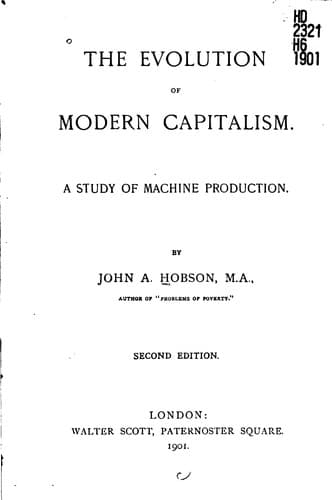
The Evolution of Modern Capitalism: A Study of Machine ProductionHobson, J. A. (John Atkinson)
History
The Evolution of Modern Capitalism: A Study of Machine Production
Hobson, J. A. (John Atkinson)
Capitalism; Industries -- History; Machinery in the workplace
Those very qualities of narrowly restricted care and judgment,
detailed attention, regularity and patience, which we see to be
characteristic of machine work, are common human qualities in the
sense that they are within the capacity of all, and that even in the
degree of their development and practice there is less difference
between the highly-trained adult mechanic and the raw "half-timer"
than in the development and practice of such powers as machinery has
superseded. It must be recognised that machinery does exercise a
certain equalising influence by assigning a larger and larger relative
importance to those faculties which are specific as compared with
those which are individual.[223] "General ability" is coming to play a
more important part in industry than specialised ability,[3] and
though considerable differences may exist in the "general ability" of
individuals, the differences will be smaller than in specialised
abilities.[224]
The net influence of machinery upon the quality of labour, then, is
found to differ widely according to the relation which subsists
between the worker and the machine. Its educative influence,
intellectual and moral, upon those concerned with the invention,
management, and direction of machine industry, and upon all whose work
is about machinery, but who are not detailed machine-tenders, is of a
distinctly elevating character. Its effect, however, upon
machine-tenders in cases where, by the duration of the working day or
the intensity of the physical effort, it exhausts the productive
energy of the worker, is to depress vitality and lower him in the
scale of humanity by an excessive habit of conformity to the automatic
movements of a non-human motor. This human injury is not adequately
compensated by the education in routine and regularity which it
confers, or by the slight understanding of the large co-operative
purposes and methods of machine industry which his position enables
him to acquire.
FOOTNOTES:
[198] Cf. _supra_, chap. iii. § 2.
[199] Karl Marx ranks the chief economies of machinery under two
heads--(1) Machinery supersedes the skill of men working with tools.
"The machine, which is the starting-point of the industrial
revolution, supersedes the workman, who handles a single tool, by a
mechanism operating with a number of similar tools, and set in motion
by a single motive power, whatever the form of that power may be." (2)
Machinery supersedes the strength of man. "Increase in the size of a
machine, and in the number of its working tools, calls for a more
massive mechanism to drive it; and this mechanism requires, in order
to overcome its resistance, a mightier moving power than that of man."
(_Capital_, vol. ii. pp. 370, 371.)
[200] _Principles of Economics_, 2nd edit., pp. 314, 322.
[201] _Der Grossbetrieb_, p. 120.
[202] _Ibid._, p. 117.
[203] Evidence given by Mr. T. Birtwistle.
Public-domain text, read in full here on John Shaqi.
Reviews
Reviews
No reviews yet
Be the first to share your thoughts on this work.
Elsewhere in the archive
Join the Discussion
Join the discussion
Sign in to leave a comment or review.
Sign InorCreate an account