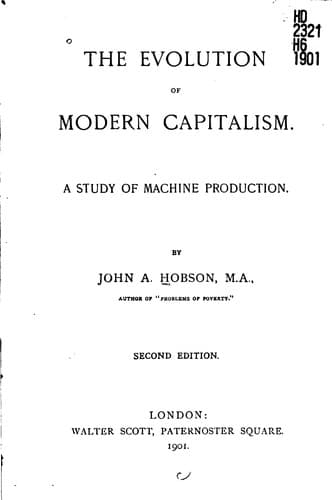
The Evolution of Modern Capitalism: A Study of Machine ProductionHobson, J. A. (John Atkinson)
History
The Evolution of Modern Capitalism: A Study of Machine Production
Hobson, J. A. (John Atkinson)
Capitalism; Industries -- History; Machinery in the workplace
The surest support of the "economy of
high wages" is the conviction that it will operate as a stimulus to
industry through increased consumption. The working classes,
especially in the United States and in England, show a growing
tendency to employ their higher wages in progressive consumption. Upon
the steady operation of this tendency the economic future of the
working classes, and of industry in general, largely depends.
FOOTNOTES:
[225] _Wealth of Nations_, vol. i. p. 86.
[226] Cf. _Northern Tour_, vol. ii. p. 86.
[227] It is true that out-and-out defenders of the factories against
early legislation sometimes had the audacity to assert the "economy of
high wages," and to maintain that it governed the practice of early
mill-owners. So Ure, "The main reason why they (_i.e._ wages) are so
high is, that they form a small part of the value of the manufactured
article, so that if reduced too low by a sordid master, they would
render his operatives less careful, and thereby injure the quality of
their work more than could be compensated by his saving in wages. The
less proportion wages bear to the value of the goods, the higher,
generally speaking, is the recompense of labour. The prudent master of
a fine spinning-mill is most reluctant to tamper with the earnings of
his spinners, and never consents to reduce them till absolutely forced
to it by a want of remuneration for the capital and skill embarked in
his business" (_Philosophy of Manufactures_, p. 330). This does not,
however, prevent Dr. Ure from pointing out a little later the grave
danger into which trade-union endeavours to raise wages drive a trade
subject to the competition of "the more frugal and docile labour of
the Continent and United States" (p. 363). Nor do Dr. Ure's statements
regarding the high wages paid in cotton-mills, which he places at
three times the agricultural wages, tally with the statistics given in
the appendix of his own book (cf. p. 515). Male spinners alone
received the "high wages" he names, and out of them had to pay for the
labour of the assistants whom they hired to help them.
[228] _Der Grossbetrieb_, p. 132. In regarding the advance of recent
average wages it should be borne in mind that the later years contain
a larger proportion of adults. In considering the net yearly wages a
deduction for unemployment should be made from the sums named in the
table.
[229] Account must be taken of the depressed condition of hand-loom
weavers, who had not yet disappeared.
[230] Here Schulze-Gaevernitz appears to strain his argument. Though
official reports lay stress upon the silver question as an important
factor in the rise of Bombay mills, there seems no doubt of the
ability of Bombay cheap labour, independently of this, to undersell
English labour for low counts of cotton in Asiatic markets. Brentano
in his work, _Hours and Wages in Relation to Production_, supports
Schulze-Gaevernitz.
Public-domain text, read in full here on John Shaqi.
Reviews
Reviews
No reviews yet
Be the first to share your thoughts on this work.
Elsewhere in the archive
Join the Discussion
Join the discussion
Sign in to leave a comment or review.
Sign InorCreate an account