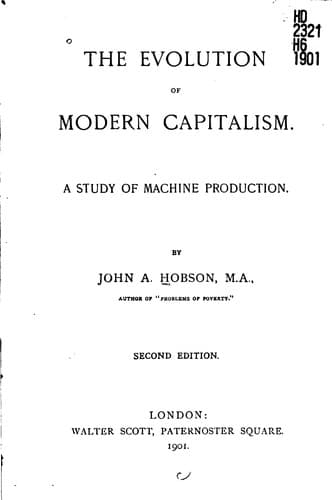
The Evolution of Modern Capitalism: A Study of Machine ProductionHobson, J. A. (John Atkinson)
History
The Evolution of Modern Capitalism: A Study of Machine Production
Hobson, J. A. (John Atkinson)
Capitalism; Industries -- History; Machinery in the workplace
[231] Mr. Gould's general conclusion, from his comparison of American
and European production, is "that higher daily wages in America _do
not mean a correspondingly enhanced labour-cost to the manufacturers_"
(_Contemporary Review_, Jan. 1893). This he holds to be partly due to
superior mechanical agencies, which owe their existence to high wages,
partly to superior physical force in the workers. But Mr. Gould's
evidence and his conclusion here stated, taken as testimony to the
"economy of high wages," are insufficient, for they only show that
high wages are attended by increased output of labour, not by an
increase _correspondent_ to this higher wage.
[232] Ure's _Philosophy of Manufactures_, pp. 367-369. Dr. Ure
regarded mechanical inventions as the means whereby capital should
keep labour in subjection. In describing how the "self-acting mule"
came into use he adds triumphantly: "This invention comprises the
great doctrine already propounded, that when capital enlists science
in her service the refractory hand of labour will always be taught
docility" (p. 368).
[233] "No. 64 Consular Report" (quoted Schoenhof, p. 209).
[234] Schoenhof, p. 216.
[235] _Der Grossbetrieb_, p. 167.
[236] _Vide supra_, p. 269. These wages, however, are the average of
all the labour employed in the weaving-sheds, not of "weavers" alone.
[237] E.R.L. Gould, _Contemporary Review_, January 1893.
CHAPTER XI.
SOME EFFECTS OF MODERN INDUSTRY UPON THE WORKERS AS CONSUMERS.
§ 1. _How far the different Working Classes gain from the Fall of
Prices._
§ 2. _Part of the Economy of Machine-production compensated by the
growing Work of Distribution._
§ 3. _The Lowest Class of Workers gains least from
Machine-production._
§ 1. In considering the effect of machine-production upon a body of
workers engaged in some particular industry we are not confined to
tracing the effects of improvements in the arts and methods of that
single branch of production. As consumers they share in the
improvements introduced into other industries reflected in a fall of
retail prices. Insomuch as all English workers consume bread they are
benefited by the establishment of a new American railway or the
invention of new milling machinery which lowers the price of bread; as
all consume boots the advantage which the introduction of boot-making
machinery confers upon the workers is not confined to the higher wages
which may be paid to some operatives in the boot factory, but is
extended to all the workers who can buy cheaper boots.
How far do methods of modern capitalist production tend to benefit the
labourer in his capacity as consumer?
Public-domain text, read in full here on John Shaqi.
Reviews
Reviews
No reviews yet
Be the first to share your thoughts on this work.
Elsewhere in the archive
Join the Discussion
Join the discussion
Sign in to leave a comment or review.
Sign InorCreate an account