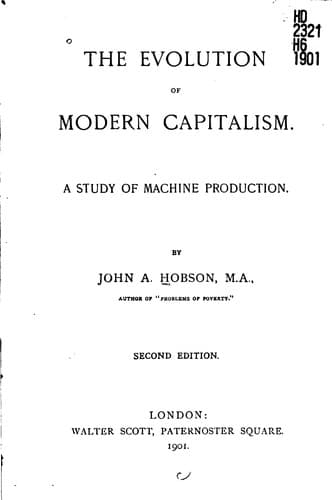
The Evolution of Modern Capitalism: A Study of Machine ProductionHobson, J. A. (John Atkinson)
History
The Evolution of Modern Capitalism: A Study of Machine Production
Hobson, J. A. (John Atkinson)
Capitalism; Industries -- History; Machinery in the workplace
Economic theory is in tolerably close accord with experience in the
answer it gives to this question. Each portion of the working classes
gains in its capacity of consumer from improved methods of production
in proportion to the amount by which its income exceeds the bare
subsistence wage of unskilled workers. The highly-paid mechanic gains
most, the sweated worker least. The worker earning forty shillings per
week gains much more than twice as much as the worker earning twenty
shillings from each general cheapening in the cost of production.
There are several reasons why this is so.
1. Where there exists a constant over-supply of labour competing for
what must be regarded at any particular time as a fixed quantity of
employment, wages are determined with tolerably close reference to the
lowest standard of living among that class of workers, and not by any
fixed or customary money wage. This is particularly the case in the
"sweating" trades of large towns. Here such improvements in machinery
and methods of industry as lower the price of articles which fall
within the "standard of living" of this class are liable to be
speedily reflected in a fall of money wages paid for such low-skilled
work. In other words, a "bare subsistence wage" does not gain by a
fall in the price of the articles which belong to its standard of
comfort.
Even in the lowest kinds of work there is no doubt some tendency to
stick to the former money wage and thus to raise somewhat the standard
of real wages, but where the competition is keenest this _vis inertiæ_
is liable to be overborne, and money wages fall with prices. As we
rise to the more highly skilled, paid, and organised grades of labour,
we come to workers who are less exposed to the direct constant strain
of competition, where there is not a chronic over-supply of labour.
Here a fall of retail prices is not necessarily or speedily followed
by any corresponding fall of money wages, and the results of the
higher real wages enjoyed for a time impress themselves in a higher
habitual standard of comfort and strengthen the resistance which is
offered to any attempt to lower money wages, even though the attempt
may be made at a time when an over-supply of labour does exist.
In proportion as a class of workers is highly paid, educated, and
organised, it is able to gain the benefit which improved machinery
brings to the consumer, because it is better able to resist the
economic tendency to determine wages by reference to a standard of
comfort independent of monetary considerations. So far as the lowest
waged and most closely competing labourers have gained by the fall of
prices, it has been due to the pressure of sentiment on the part of
the better class of employers and of the public against the lowering
of money wages, even where the smaller sum of money will purchase as
much as a larger sum previously.
Public-domain text, read in full here on John Shaqi.
Reviews
Reviews
No reviews yet
Be the first to share your thoughts on this work.
Elsewhere in the archive
Join the Discussion
Join the discussion
Sign in to leave a comment or review.
Sign InorCreate an account