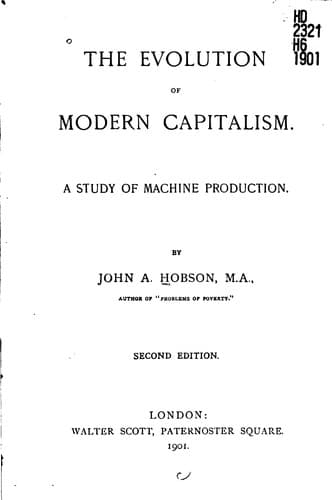
The Evolution of Modern Capitalism: A Study of Machine ProductionHobson, J. A. (John Atkinson)
History
The Evolution of Modern Capitalism: A Study of Machine Production
Hobson, J. A. (John Atkinson)
Capitalism; Industries -- History; Machinery in the workplace
2. The smaller the income the larger the proportion of it that is
spent upon commodities whose expense of production and whose price is
less affected by machinery. Machine-production, by the fall of prices
it brings, has benefited people in direct proportion to their income.
The articles which have fallen most rapidly in price are those
comforts and luxuries into which machine-production enters most
largely. The aristocracy of the working classes, whose standard of
comfort includes watches, pianos, books, and bicycles, has gained much
more by the fall of prices than those who are obliged to spend all
their wages on the purchase of bare necessaries of life. The gain of
the former is manifold and great, the benefit of the latter is
confined to the cheapening of bread and groceries--a great benefit
when measured in terms of improved livelihood no doubt, but small when
compared with the increase of purchasing power conferred by modern
production upon the Lancashire factory family, with its £3 or £4 a
week, and in large measure counterbalanced by the increased proportion
of the income, which, in the case of town operatives, goes as rent and
price of vegetables, dairy produce, and other commodities which have
risen in price.
3. The highly-paid operatives generally work the shortest hours, the
low-paid the longest. So far as this is not compensated by an
increased intensity of labour on the part of those working short
hours, it implies an increased capacity of making the most out of
their wages. Longer leisure enables a worker to make the most of his
consumption, he can lay out his wages more carefully, is less tempted
to squander his money in excesses directly engendered by the reaction
from excessive labour, and can get a fuller enjoyment and benefit from
the use of the consumables which he purchases. A large and increasing
number of the cheapest and the most intrinsically valuable
commodities, of an intellectual, artistic, and spiritual character,
are only open to the beneficial consumption of those who have more
leisure at their command than is yet the lot of the low-skilled
workers in our towns.
§ 2. If we compare the statistics of wages we shall find that the
largest proportionate rise of money wages has been in the
highly-organised machine industries, and that the benefit which
machinery confers upon the workers in the capacity of consumers falls
chiefly to the same workers.
Public-domain text, read in full here on John Shaqi.
Reviews
Reviews
No reviews yet
Be the first to share your thoughts on this work.
Elsewhere in the archive
Join the Discussion
Join the discussion
Sign in to leave a comment or review.
Sign InorCreate an account