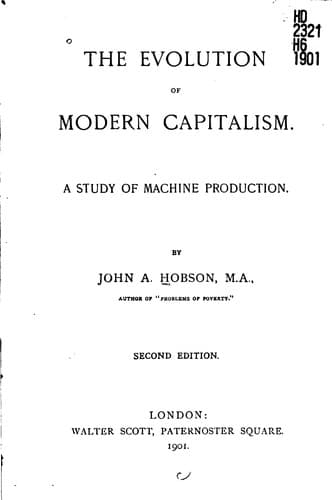
The Evolution of Modern Capitalism: A Study of Machine ProductionHobson, J. A. (John Atkinson)
History
The Evolution of Modern Capitalism: A Study of Machine Production
Hobson, J. A. (John Atkinson)
Capitalism; Industries -- History; Machinery in the workplace
It must not, however, be assumed that improved methods of production
yield their full benefit through competition to the consuming public.
On the contrary, much of the economy of machine-production fails to
exercise its full influence upon retail prices. There are two chief
reasons for this failure. To one of these adequate attention has been
already drawn, the growth of definite forms of capitalist monopoly,
which secure at some point or other in the production of a commodity,
as higher profits, that which under free competition would pass to the
consumer through lower shop prices. The second consists in the
abnormal growth of the distributive classes, whose multiplication is
caused by the limitation which the economy of machinery imposes upon
the amount of capital and labour which can find profitable employment
in the extractive and manufacturing processes. A larger and larger
number of industrial workers obtain a living by a subdivision of the
work of distribution carried to a point far beyond the bounds of
social utility. For, on the one hand, when competition of
manufacturers and transporters is more and more confined to a small
number of large businesses which, because their united power of
production largely transcends the consumption at profitable prices,
are driven into closer competition, a larger amount of labour is
continually engaged in the attempt of each firm to secure for itself
the largest share of business at the expense of another firm. On the
other hand, shut out from effective or profitable competition in the
manufacturing industries, a larger amount of capital and labour seeks
to engage in those departments of the distributive trade where
new-comers have a better chance, and where by local settlement or
otherwise they have an opportunity of sharing the amount of
distribution that is to be done. Hence a fall of wholesale prices is
usually not reflected in a corresponding fall of retail prices, for
competition in retail trade, as J.S. Mill clearly recognised, "often,
instead of lowering prices, merely divides the gains of the high price
among a greater number of dealers."[238]
Public-domain text, read in full here on John Shaqi.
Reviews
Reviews
No reviews yet
Be the first to share your thoughts on this work.
Elsewhere in the archive
Join the Discussion
Join the discussion
Sign in to leave a comment or review.
Sign InorCreate an account