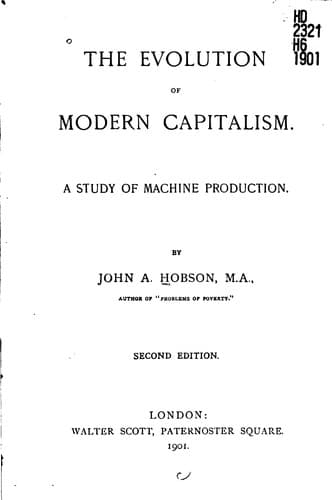
The Evolution of Modern Capitalism: A Study of Machine ProductionHobson, J. A. (John Atkinson)
History
The Evolution of Modern Capitalism: A Study of Machine Production
Hobson, J. A. (John Atkinson)
Capitalism; Industries -- History; Machinery in the workplace
§ 3. The wide difference between the economic position of the skilled
mechanic and the common labourer shows how fallacious is that
treatment of the influence of machinery upon the condition of the
working classes which is commonly found in treatises of political
economy. To present a comparative picture of the progress of the
working classes during the last half century, which assigns to them an
increase of money wages, obtained by averaging a number of rises in
different employments, and reduces this increase to real wages without
any reference to the different use of wages by different classes, is
an unscientific and mischievous method of dealing with one of the most
important economic questions. The influence of machine-production
appears to be widely different upon the skilled mechanic and the
common labourer considered both as producers and consumers, and tends
to a wide difference in standard of comfort between the two classes.
This difference is further enhanced by the indirect assistance which
machinery and large-scale industry gives to the skilled workers to
combine and thus frequently to secure wages higher than are
economically requisite to secure their efficient work. On the other
hand, growing feelings of humanity and a vague but genuine feeling of
social justice in an ever larger portion of the public often enable
the low-skilled worker to secure a higher standard of comfort than the
operation of economic competition alone would enable him to reach. But
after due allowance is made for this, the conclusion is forced upon us
that the gain of machine-production, so far as an increase in real
wages is concerned, has been chiefly taken by the highly-skilled and
highly-waged workers, and that as the character of work and wages
descends, the proportionate gain accruing from the vast increase of
productive power rapidly diminishes, the lowest classes of workers
obtaining but an insignificant share.
FOOTNOTES:
[238] _Principles of Political Economy_, Bk. ii., chap. iv. § 3.
CHAPTER XII.
WOMEN IN MODERN INDUSTRY.
Public-domain text, read in full here on John Shaqi.
Reviews
Reviews
No reviews yet
Be the first to share your thoughts on this work.
Elsewhere in the archive
Join the Discussion
Join the discussion
Sign in to leave a comment or review.
Sign InorCreate an account