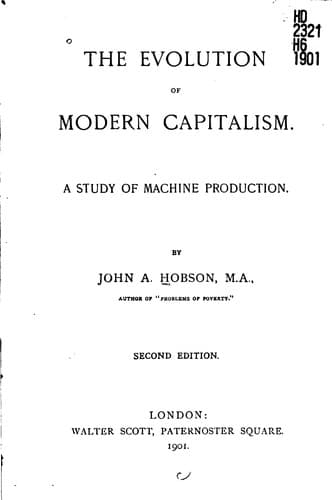
The Evolution of Modern Capitalism: A Study of Machine Production — John Shaqi
The Evolution of Modern Capitalism: A Study of Machine ProductionHobson, J. A. (John Atkinson)
History
The Evolution of Modern Capitalism: A Study of Machine Production
Hobson, J. A. (John Atkinson)
Capitalism; Industries -- History; Machinery in the workplace
Nottingham and Leicester were beginning to specialise in cotton and
woollen hosiery, but a good deal was made round London, and generally
in the woollen counties of the south. Silk was more specialised owing
to the importation of special skill and special machinery to
Spitalsfield, Stockport, Derby, and a few other towns. In Coventry it
was only the second trade in 1727.[31]
The scattered crafts of the wheelwright, the smith, carpenter, turner,
carried on many of the subsidiary processes of building, manufacture
of vehicles and furniture, which are now for the most part highly
centralised industries.
When we come presently to consider the structure of the several
industries we shall see that even those trades which are allocated to
certain local areas are much less concentrated within these areas than
is now the case.
But though stress is here laid upon the imperfect differentiation of
localities in industry, it is not to be supposed that the eighteenth
century shows England a simple industrial community with no
considerable specialisation.
Three conditions of specialised industry are clearly discernible in
the early eighteenth century--conditions which always are among the
chief determinants.
1. _Physical aptitudes of soil_--_e.g._, since timber was still used
almost entirely for smelting, iron works are found where timber is
plentiful or where river communication makes it easily procurable. So
the more fertile meadows of Gloucester and Somerset led these
districts to specialise in the finer branches of the woollen trade. A
still more striking example is that of South Lancashire. By nature it
was ill-suited for agriculture, and therefore its inhabitants employed
themselves largely in the cotton and woollen trades. The numerous
little streams which flowed from the hills to the neighbouring sea
gave plenty of water-power, and thus made this district the home of
the earlier mills and the cradle of machine-industry.[32] The "grit"
of the local grindstones secured the supremacy of Sheffield cutlery,
while the heavy clay required for the "seggars," or boxes in which
pottery is fired, helped to determine the specialisation of
Staffordshire in this industry.[33]
2. _Facility of Market._--The country round London, Bristol, and other
larger towns became more specialised than the less accessible and more
evenly populated parts, because the needs of a large town population
compelled the specialisation in agriculture of much of the surrounding
country; cottagers could more easily dispose of their manufactures;
improved roads and other facilities for conveyance induced a
specialisation impossible in the purely rural parts.
Public-domain text, read in full here on John Shaqi.
Reviews
Reviews
No reviews yet
Be the first to share your thoughts on this work.
Join the Discussion
Join the discussion
Sign in to leave a comment or review.
Sign InorCreate an account