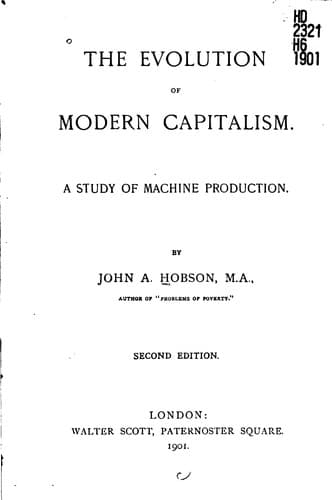
The Evolution of Modern Capitalism: A Study of Machine ProductionHobson, J. A. (John Atkinson)
History
The Evolution of Modern Capitalism: A Study of Machine Production
Hobson, J. A. (John Atkinson)
Capitalism; Industries -- History; Machinery in the workplace
3. _The Nature of the Commodity._--When all modes of conveyance were
slow the degree of specialisation depended largely upon the keeping
quality of the goods. From this point of view hardware and textiles
are obviously more amenable to local specialisation than the more
perishable forms of food. Where conveyance is difficult and expensive
a commodity bulky for its value is less suitable for local
specialisation in production than one containing a high value in small
weight and bulk. So cloth is more suitable for trade than corn;[34]
and coal, save where navigation is possible, could not be profitably
taken any distance.[35]
The common commodities consumed, as food, fuel, and shelter, were thus
excluded from any considerable amount of specialisation in their
production.
§ 8. Turning from consideration of the attributes of goods and of the
means of transport which served to limit the character of internal
trade and determine the size of the market, let us now regard the
structure of the market, the central object in the mechanism of
internal commerce.
The market, not the industry, is the true term which expresses the
group of organically related businesses. How far did England present a
national market? How far was the typical market a district or purely
local one?
The one great national market town was London. It alone may be said to
have drawn supplies from the whole of England, and there alone was it
possible to purchase at any season of the year every kind of produce,
agricultural or manufactured, made anywhere in England or imported
from abroad. This flow to and from the great centre of population was
incessant, and extended to the furthermost parts of the land. Other
large towns, such as Bristol, Leeds, Norwich, maintained close and
constant relations with the neighbouring counties, but exchanged their
produce for the most part only indirectly with that of more distant
parts of the country.
The improving communication of the eighteenth century enabled the
clothiers and other leading manufacturers to distribute more of their
wares even in the remotest parts of the country, but the value paid
for their wares reached the vendors by slow and indirect channels of
trade, passing for the most part through the metropolis.
But while London was the one constant national market-place, national
trade was largely assisted by fairs held for several weeks each year
at Stourbridge, Winchester, and other convenient centres. At the most
important of these the large merchants and manufacturers met their
customers, and business was transacted between distant parts of the
country, including all kinds of wares, English and foreign. Thus we
had one constant and two or three intermittent avenues of free
national trade. The great bulk of markets, however, were confined
within far smaller areas.
Public-domain text, read in full here on John Shaqi.
Reviews
Reviews
No reviews yet
Be the first to share your thoughts on this work.
Join the Discussion
Join the discussion
Sign in to leave a comment or review.
Sign InorCreate an account