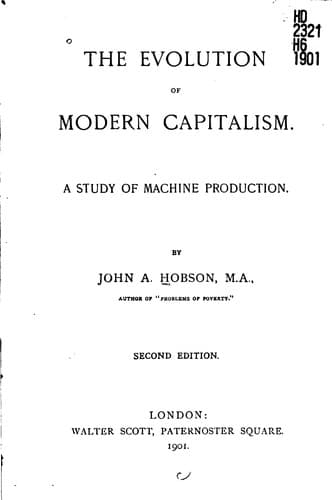
The Evolution of Modern Capitalism: A Study of Machine ProductionHobson, J. A. (John Atkinson)
History
The Evolution of Modern Capitalism: A Study of Machine Production
Hobson, J. A. (John Atkinson)
Capitalism; Industries -- History; Machinery in the workplace
In the more highly developed and specialised textile trades certain
regular market-places were established of wide local importance. The
largest of these specialised district markets were at Leeds, Halifax,
Norwich, and Exeter. Here the chief local manufacturers of cloth,
worsted, or crape met the merchants and factors and disposed of their
wares to these distributing middlemen.
It was, however, in the general market-places of the county town or
smaller centres of population that the mass of the business of
exchange was transacted. There the mass of the small workers in
agriculture and manufacture brought the product of their labour and
sold it, buying what they needed for consumption and for the pursuance
of their craft. Only in considerable towns were there to be found in
the earlier eighteenth century any number of permanent shops where all
sorts of wares could be bought at any time. The weekly market in the
market-town was the chief medium of commerce for the great mass of the
population.
Regarding the general structure of Industry we see that not only are
international bonds slight and unessential, but that within the nation
the elements of national cohesion are feeble as compared with those
which subsist now. We have a number of small local communities whose
relations, though tolerably strong with other communities in their
immediate neighbourhood, become greatly weakened by distance. For the
most part these small communities are self-sufficing for work and
life, producing most of their own necessaries, and only dependent on
distant and unknown producers for their comforts and luxuries.
Trade is for the most part conducted on a small steady local basis
with known regular customers.
Outside of agriculture the elements of speculation and fluctuation are
almost entirely confined to foreign trade. Capital and labour are
fixed to a particular locality and a particular business.[36]
§ 9. Turning to the structure of the several industries we find that
different employments are not sharply separated from one another. In
the first place, agriculture and manufacture are not only carried on
in the same locality but by the same people. This combined agriculture
and manufacture took several forms.
The textile industries were largely combined with agriculture. Where
spinning was carried on in agricultural parts there was, for the most
part, a division of labour within the family. The women and children
spun while the men attended to their work in the fields.[37] Every
woman and child above the age of five found full employment in the
spinning and weaving trades of Somerset and the West Riding.[38]
Public-domain text, read in full here on John Shaqi.
Reviews
Reviews
No reviews yet
Be the first to share your thoughts on this work.
Join the Discussion
Join the discussion
Sign in to leave a comment or review.
Sign InorCreate an account