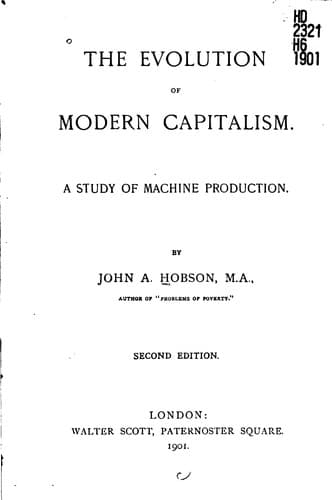
The Evolution of Modern Capitalism: A Study of Machine Production — John Shaqi
The Evolution of Modern Capitalism: A Study of Machine ProductionHobson, J. A. (John Atkinson)
History
The Evolution of Modern Capitalism: A Study of Machine Production
Hobson, J. A. (John Atkinson)
Capitalism; Industries -- History; Machinery in the workplace
Not only were agriculture and many forms of manufacture conjoined, but
the division of labour and differentiation of processes within the
several industries was not very far advanced. The primitive tillage of
the common-fields which still prevailed in the early eighteenth
century, though the rapid enclosure of commons was effecting a
considerable, and from the wealth-producing point of view, a very
salutary change, did not favour the specialisation of land for pasture
or for some particular grain crops. Each little hamlet was engaged in
providing crops of hay, wheat, barley, oats, beans, and had to fulfil
the other purposes required by a self-subsisting community. This
partly arose from the necessity of the system of land tenure, partly
from ignorance of how to take advantage of special qualities and
positions of soil, and partly from the self-sufficiency improved by
difficulties of conveyance. As the century advanced, the enclosure of
commons, the increase of large farms, the application of new science
and new capital led to a rapid differentiation in the use of land for
agricultural purposes. But in the earlier part of the century there
was little specialisation of land except in the West Riding and round
the chief centres of the woollen trade, and to a less extent in the
portions of the counties round London whose position forced them to
specialise for some particular market of the metropolis.
§ 10. As the small agriculturist on a self-sufficing farm must perform
many different processes, so the manufacturer was not narrowed down to
a single process of manufacture. A large part of the ruder
manufactures were home productions for home consumption, and the same
hands tended the sheep which furnished the wool, and spun and wove the
wool for family use. The smith was in a far fuller sense the maker of
the horse-shoe or the nail or bolt than he is to-day; the wheelwright,
the carpenter, and other handicraftsmen performed a far larger number
of different processes than they do now. Moreover, each household, in
addition to its principal employments of agriculture and manufacture,
carried on many minor productive occupations, such as baking, brewing,
butter-making, dressmaking, washing, which are now for the most part
special and independent branches of employment.
Public-domain text, read in full here on John Shaqi.
Reviews
Reviews
No reviews yet
Be the first to share your thoughts on this work.
Join the Discussion
Join the discussion
Sign in to leave a comment or review.
Sign InorCreate an account