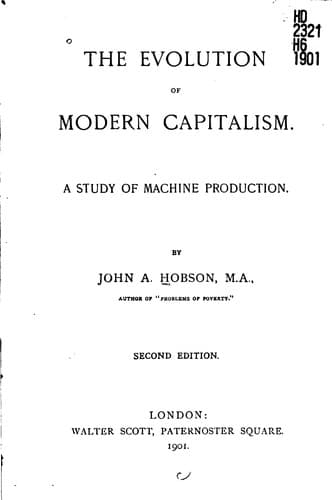
The Evolution of Modern Capitalism: A Study of Machine ProductionHobson, J. A. (John Atkinson)
History
The Evolution of Modern Capitalism: A Study of Machine Production
Hobson, J. A. (John Atkinson)
Capitalism; Industries -- History; Machinery in the workplace
In the more highly-developed branches of the textile and metal trades
the division of processes appears at first sight more sharply marked
than to-day. The carder, spinner, weaver, fuller in the cloth trade
worked in the several processes of converting raw wool into finished
cloth, related to one another only by a series of middlemen who
supplied them with the material required for their work and received
it back with the impress of their labour attached, to hand it out once
more to undergo the next process.[41] But though modern
machine-production will show us these various processes drawn together
into close local proximity, sometimes performed under the same roof
and often making use of the same steam power, we shall find that a
chief object and effect of this closer local co-ordination of the
several processes is to define and narrow more precisely the labour of
each worker and to make the spinner and the weaver confine himself to
the performance of a fractional part of the full process of spinning
or weaving. Thus we find that English industry in the early eighteenth
century is marked on the one hand by a lack of clear differentiation
as regards industries, and on the other hand by a lack of minute
differentiation of processes within the industry.
§ 11. We must now descend from the consideration of the Industry and
the Market, or group of related businesses, to examine the character
and structure of the unit of industry--the Business.
In a study of the composition or co-operation of labour and capital in
a Business before the era of machine-production there are five points
of dominant importance--(1) The ownership of the material; (2) the
ownership of the tools; (3) the ownership of the productive power; (4)
the relations subsisting between the individual units of labour; (5)
the work-place.
English manufacturing industry in the first half of the eighteenth
century furnishes a variety of different forms of business of widely
different nature and complexity. The simplest form of manufacturing
industry is that in which an industrial family owning the raw material
and the requisite tools, and working with the power of their own
bodies in their own homes, produce commodities for their own
consumption. This private production for private consumption survived
largely in the eighteenth century, not merely in the case of
agriculturists who produced the more necessary articles of food for
themselves as well as for the market, but also in the case of farmers
and cottagers in the remotest parts of the country who produced their
own wool and flax, and spun and wove it for their own use.[42]
From this primitive form which required no commerce and no industrial
organisation we may trace the growth of various forms of higher
industrial development, many of which co-existed in eighteenth century
England.
Public-domain text, read in full here on John Shaqi.
Reviews
Reviews
No reviews yet
Be the first to share your thoughts on this work.
Join the Discussion
Join the discussion
Sign in to leave a comment or review.
Sign InorCreate an account