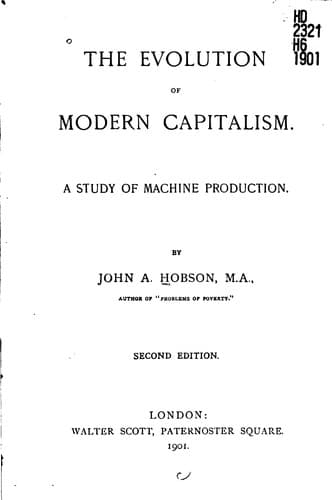
The Evolution of Modern Capitalism: A Study of Machine ProductionHobson, J. A. (John Atkinson)
History
The Evolution of Modern Capitalism: A Study of Machine Production
Hobson, J. A. (John Atkinson)
Capitalism; Industries -- History; Machinery in the workplace
But although the economy of mechanical power was not yet operative to
any appreciable extent in concentrating labour, certain other notable
economics of large-scale production were beginning to assert
themselves in all the leading manufactures. Indeed so powerful are
some of the economies of division of labour and co-operation even in a
primitive condition of the industrial arts, that Professor Ashley
considers it not improbable that the great manufactory might have
become an important or even a dominant feature of the woollen trade as
early as the sixteenth century, if legislative enactments had not
stood in the way.[49] As it was, these earlier centralising forces,
while they drove the workers to work and live in closer and compacter
masses, did not at first dispose them in factories to any great
extent. They continued for the most part to work in their own houses,
though for material and sometimes for the implements of their craft
they were dependent upon some merchant or large master-manufacturer.
This was the condition of industry in the neighbourhood of Leeds in
1725. "The houses are not scattered and dispersed as in the vicarage
of Halifax, one by one, but in villages, and those houses thronged
with people and the whole country infinitely populous."[50] In the
more highly-developed branches of the cloth trade, however, where the
best looms were a relatively costly form of capital, the foundation of
the factory system was clearly laid. In Norwich, Frome, Taunton,
Devizes, Stourbridge, and other clothing centres, Defoe found the
weaving industry highly concentrated, and rich employers owning
considerable numbers of looms. Some of this work was put out by the
master-manufacturers, but other work was done in large sheds or other
premises owned by the master. This large organised "business," half
factory, half domestic, continued to prevail in the important West of
England clothing industry up to the close of the eighteenth century.
"The master clothier of the West of England buys his wool from the
importer, if it be foreign, or in the fleece if it be of domestic
growth; after which, in all the different processes through which it
passes, he is under the necessity of employing as many distinct
classes of persons; sometimes working in their own houses, sometimes
in that of the master clothier, but none of them going out of their
proper line. Each class of workman, however, acquires great skill in
performing its particular operation, and hence may have arisen the
acknowledged excellence, and, till of late, the superiority of the
cloths of the West of England."[51]
Public-domain text, read in full here on John Shaqi.
Reviews
Reviews
No reviews yet
Be the first to share your thoughts on this work.
Join the Discussion
Join the discussion
Sign in to leave a comment or review.
Sign InorCreate an account